Do Smart Rings Suck? 💍 11 Reasons I Hate Them (and Still Wear Them)
I love smart rings. I’ve tested them for years and worn dozens. So here’s what reviews skip: the two-year battery, the warranty lottery, swollen cells and more.

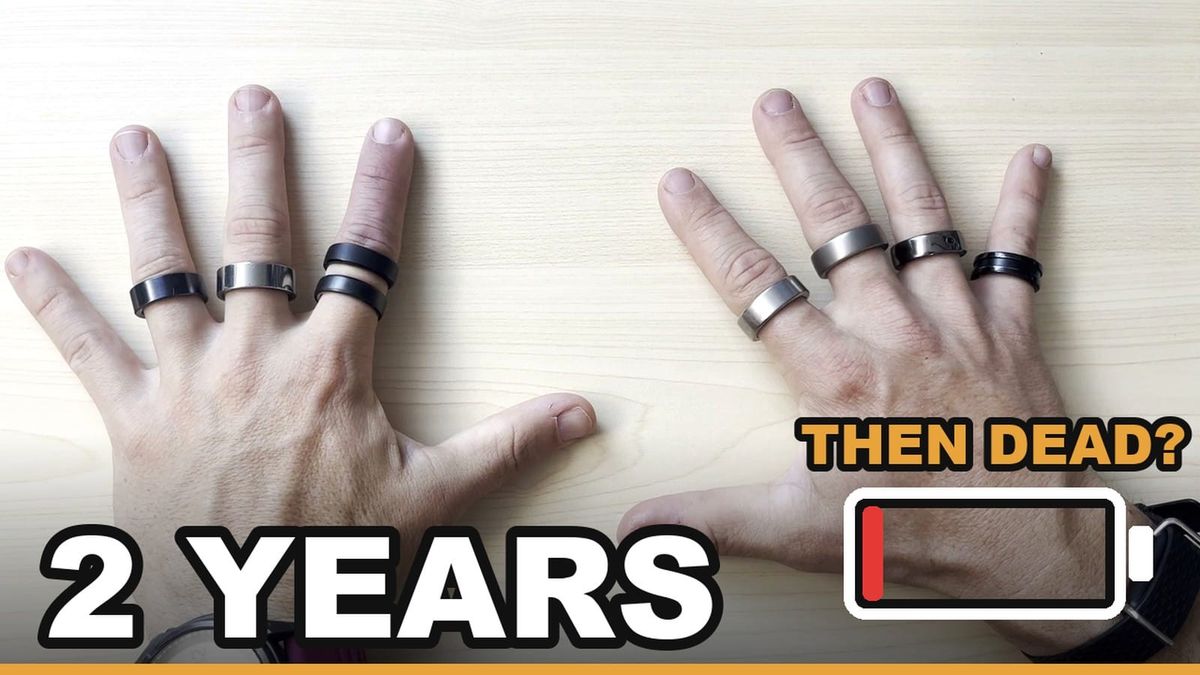
I've been wearing smart rings since 2019. More of them have passed through my hands (and mostly my fingers) than through anyone else's I know. Oura, Ultrahuman, RingConn, Circular, Samsung, Amazfit, Chinese no-names from AliExpress, even Czech brands like Niceboy and Tesla. I test them long-term and check how accurately they actually pull data out of your finger.
And that's exactly why I'm writing the article no marketing team would ever publish. Smart rings have a few fundamental flaws that reviews barely mention, or don't mention at all. Not because reviewers hide them, but because they only show up after a year or two. Long after the review went live, and long after a one-week brand collaboration where the reviewer had no chance to notice.
I'm not relying only on my own rings, though. I went through dozens of Reddit threads, forums, Trustpilot and the official warranty terms of each brand. Everything is linked and screenshotted below, so you can make up your own mind.
🔋 1. Battery: a two-year ring
Let me start with a claim I'm willing to sign: any smart ring has a real-world lifespan of roughly two years. Then the battery starts draining fast, the ring stops measuring reliably, it has connection issues and you end up charging it every day. In the worse case, the battery swells. iFixit shows it nicely in a video with a very telling title, "This $400 Ring Is Designed to Die":
Why the battery?
Inside the ring there's a tiny curved lithium-polymer cell with a capacity in the tens of mAh. For comparison, a phone has around 5,000 mAh. And that tiny cell:
- sits on your skin 24/7, so it lives permanently at around 30–35 °C (86–95 °F), and constant heat is one of the main accelerators of lithium battery ageing,
- has zero reserve. A phone battery ages too, but it's huge in comparison, so you notice the losses much more slowly than on a ring,
- can't be replaced. The electronics are usually potted in resin or sealed in metal. When the battery goes, the whole ring goes.
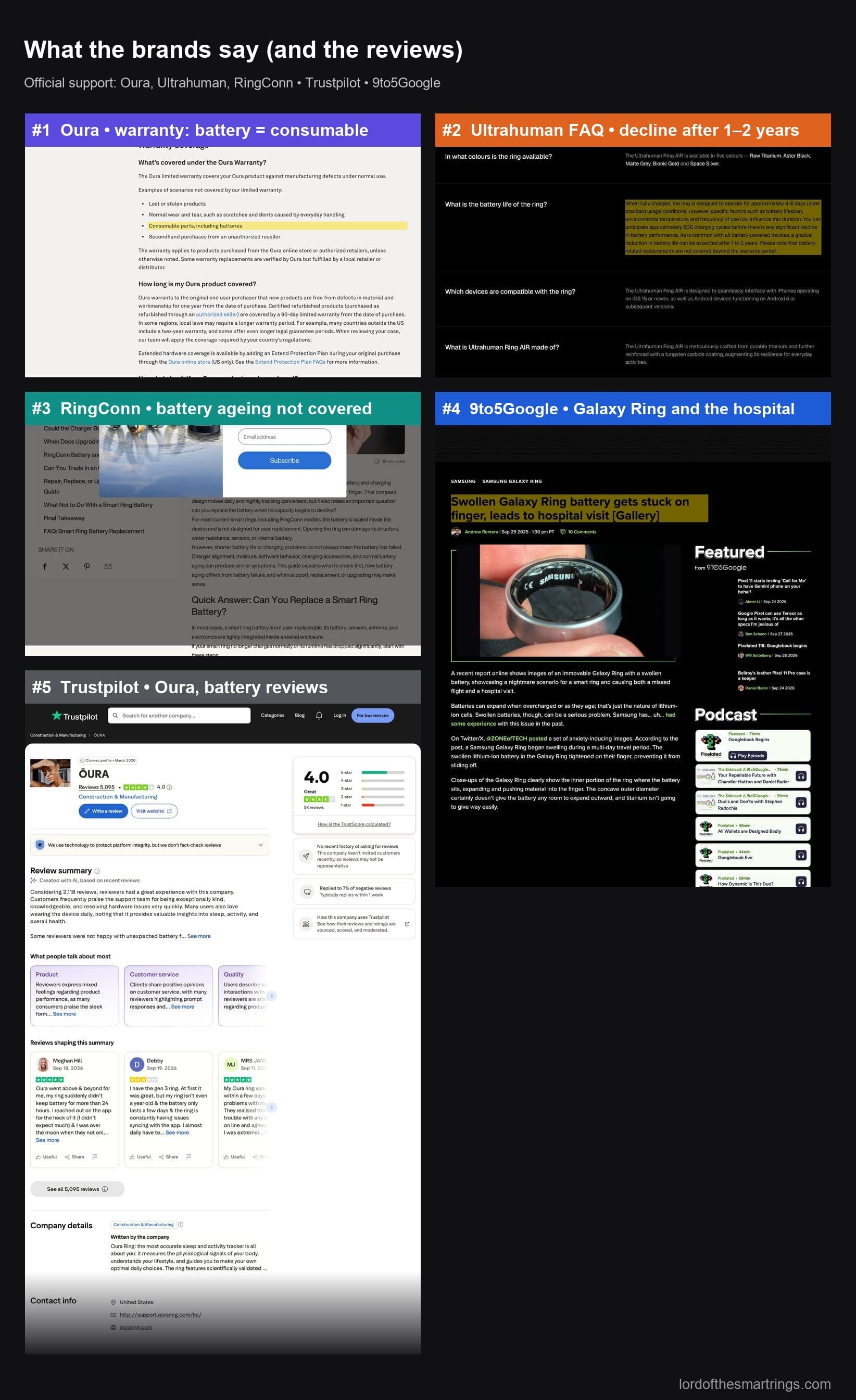
By the way, Ultrahuman admits this quite transparently in its FAQ: expect roughly 500 charge cycles and a drop in battery life after one to two years. And battery replacements aren't covered after the warranty. So there we have it, in black and white, straight from the manufacturer.
Oura Gen 2 and Gen 3: two years, three tops
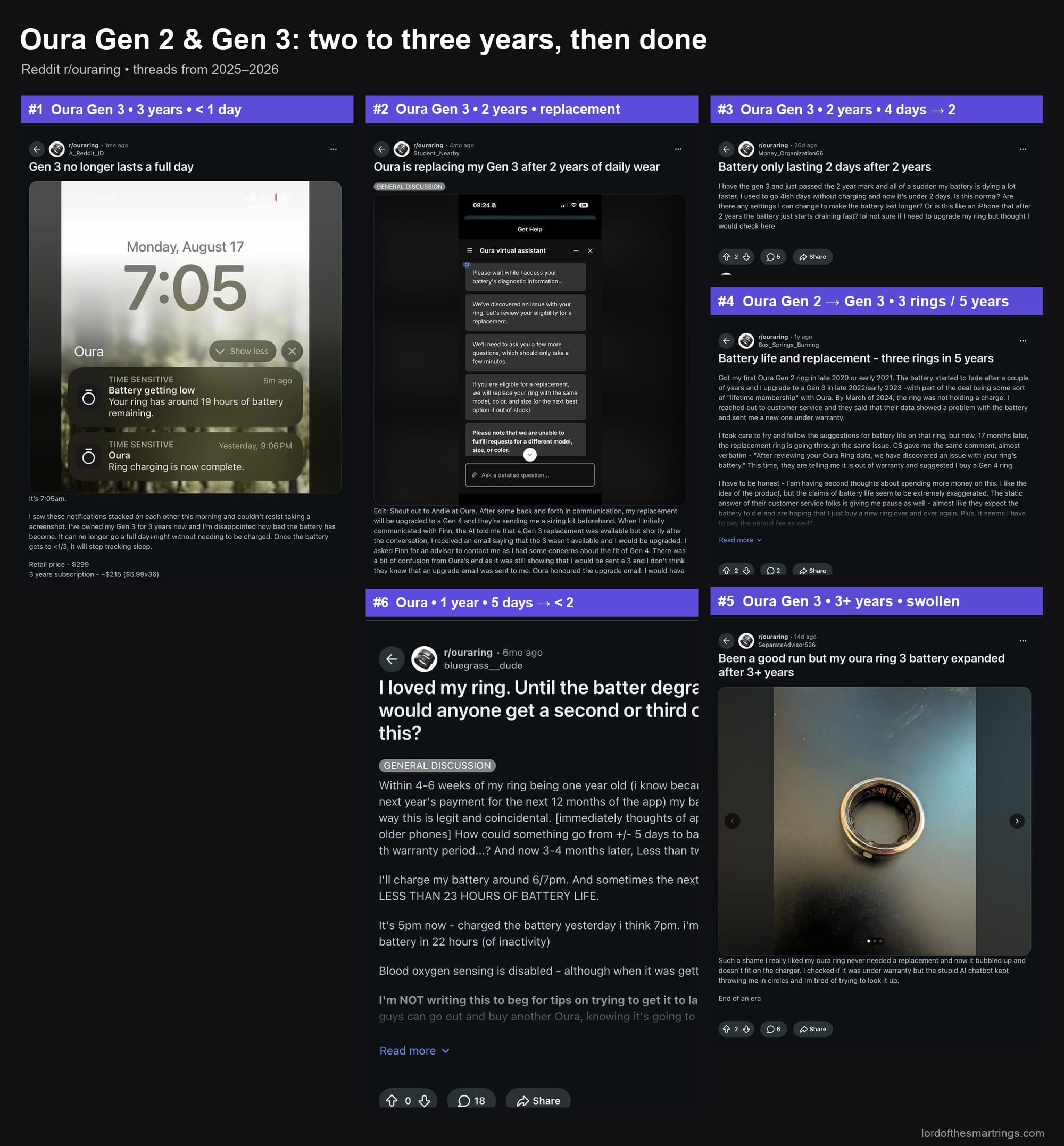
Oura is the most popular smart ring, so logically it also collects the most complaints. With the older generations the pattern repeats with suspicious regularity: two, maybe three good years, then a fast decline. In one thread someone did the maths: a $299 ring plus three years of membership (about $215) = $515 for a ring that no longer lasts a day and a night.
Another one: 7 a.m., a three-year-old Gen 3 and a notification that the battery will last 19 hours. Or this one: Gen 2, then Gen 3, then a replacement. Three rings in five years, and the same story every time.
Sources: #1 · #2 · #3 · #4 · #5 · #6
Oura 4 and Oura 5: one year (and sometimes not even that)
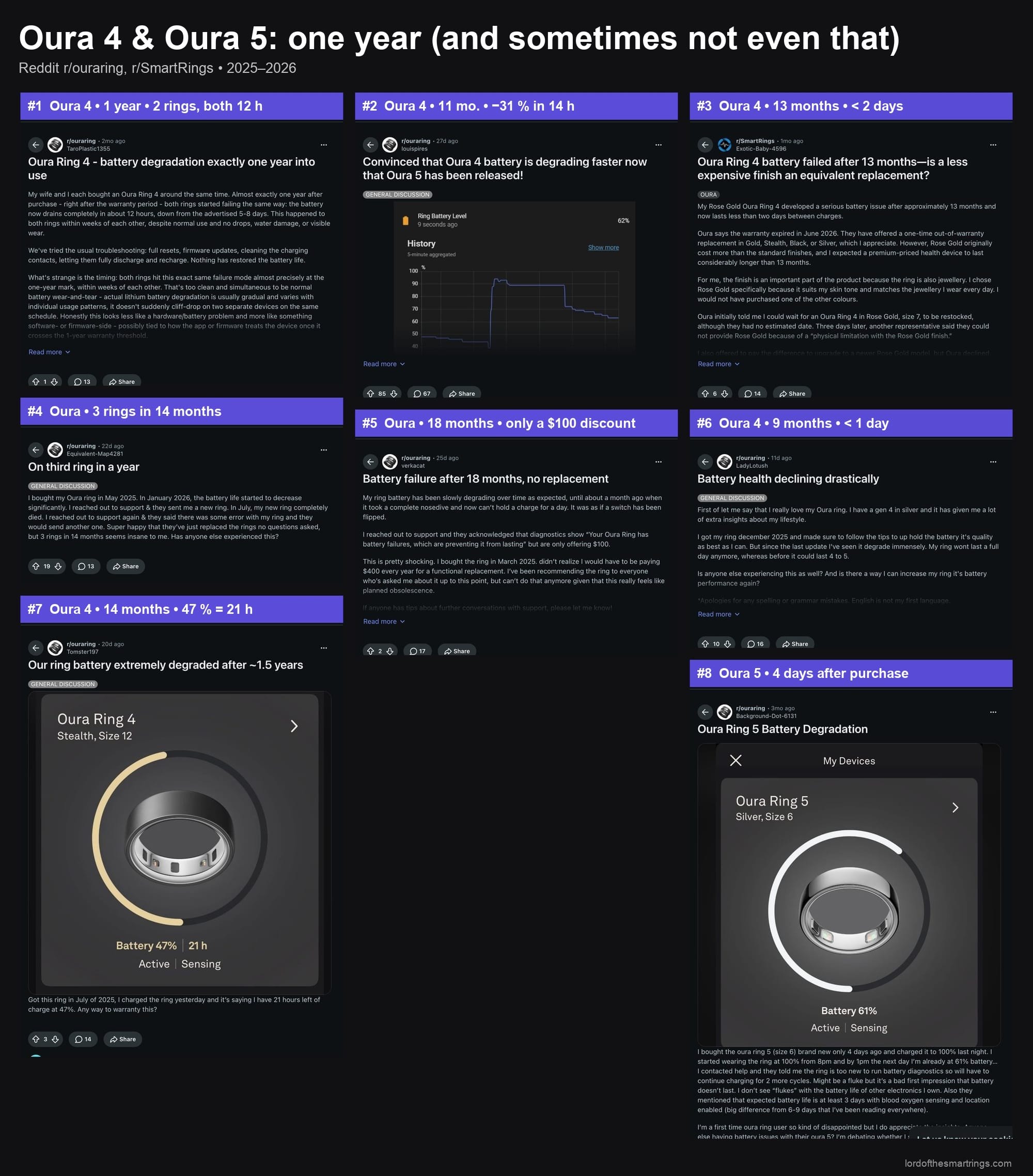
With the Oura Ring 4 it's paradoxically worse. There are so many "battery died after a year" posts on r/ouraring that someone suggested the moderators should start a dedicated megathread. The recurring themes:
- the battery fades shortly after the one-year warranty ends (many people say "suspiciously precisely"),
- "third ring in 14 months", "I'm on my fourth Oura 4", "9 months per ring on average",
- and the first complaints already show up for the Oura 5, in one case just a few days after purchase.
Two Oura 4 rings in one household, both failing right after a year, both lasting 12 hours, so basically one night. Or a battery graph showing −31 % in 14 hours on a ring that's not even a year old.
Shrinking the ring body is cool, really impressive engineering. But the other side of the coin (or the ring) has to show up somewhere.
Sources: #1 · #2 · #3 · #4 · #5 · #6 · #7 · #8
To be fair: Oura is usually generous with warranty claims. In the comments you'll find plenty of people who got a new ring for free after running the in-app diagnostics, often even out of warranty. But it's a lottery. In another case, after 18 months, the only offer was a $100 discount on a new ring.
Samsung Galaxy Ring and Ultrahuman AIR
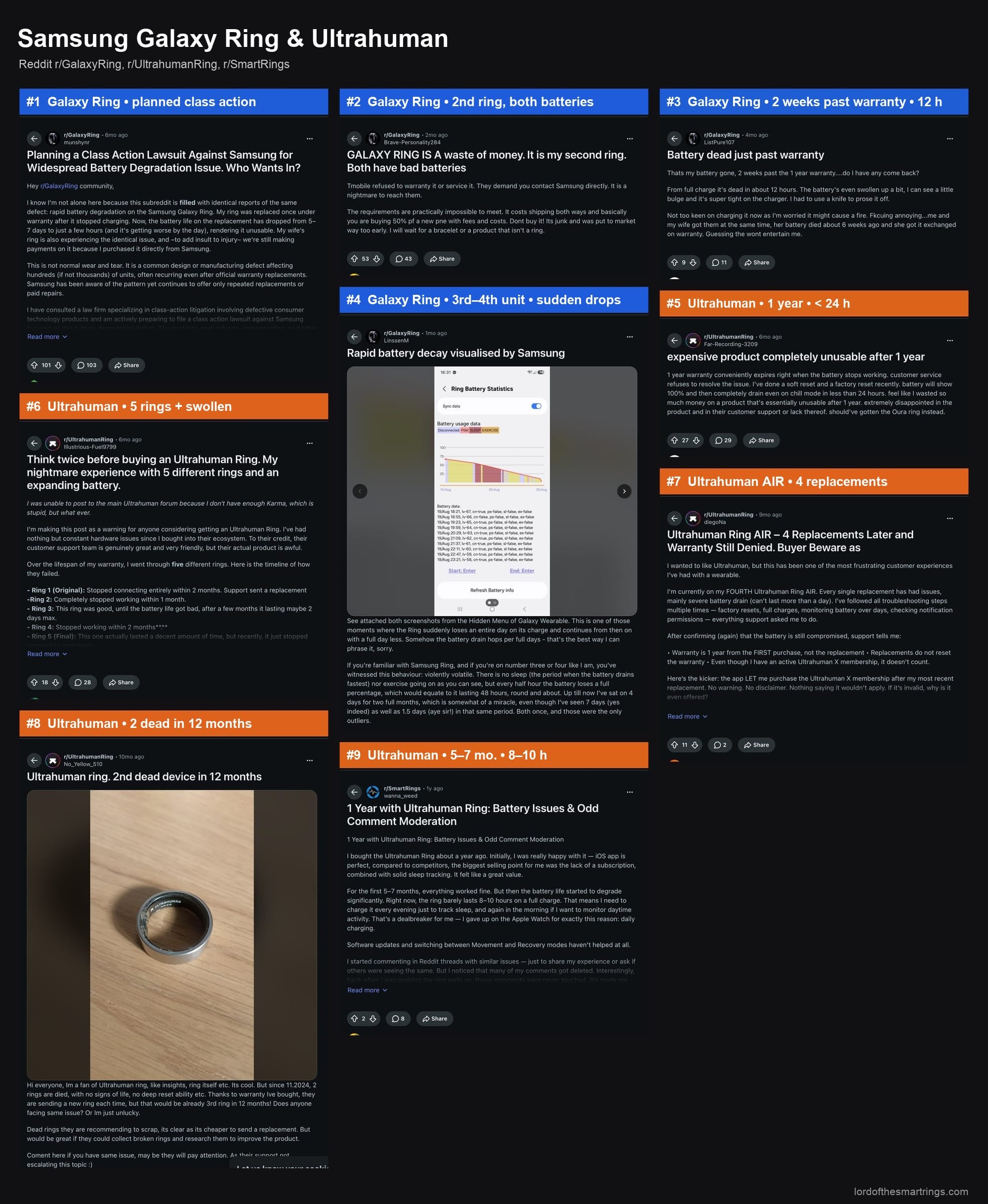
The Galaxy Ring has perhaps the worst reputation of them all on Reddit. The r/GalaxyRing community discussed a planned class action lawsuit over battery degradation. People write about their third or fourth unit and about battery life that drops by a full day overnight. I think it's the same phenomenon as everywhere else, Samsung users just weren't prepared for it, because it was the first smart ring in the Samsung ecosystem. One example: two weeks past warranty, a 12-hour battery and a ring so swollen it had to be pried off the charger with a knife.
Ultrahuman? "Five rings during one warranty period", "four replacements and then a denied claim", "unusable after a year". Five rings within one warranty is really, really frustrating. On Trustpilot, Ultrahuman had a rating of 2.6 out of 5 at the time of writing.
A quick side note: most of those Ultrahuman cases are the AIR, which had big manufacturing problems, and Ultrahuman replaced many rings because of other hardware issues, not the battery. I've been testing the Ultrahuman Ring PRO for a while now and so far I haven't noticed any battery complaints. It's bigger, so maybe there's more capacity inside (Ultrahuman doesn't publish the exact numbers). But it's only been on the market for a short time, so it's too early to judge.
Sources: #1 · #2 · #3 · #4 · #5 · #6 · #7 · #8 · #9
RingConn, Circular, Amazfit Helio… and basically everyone
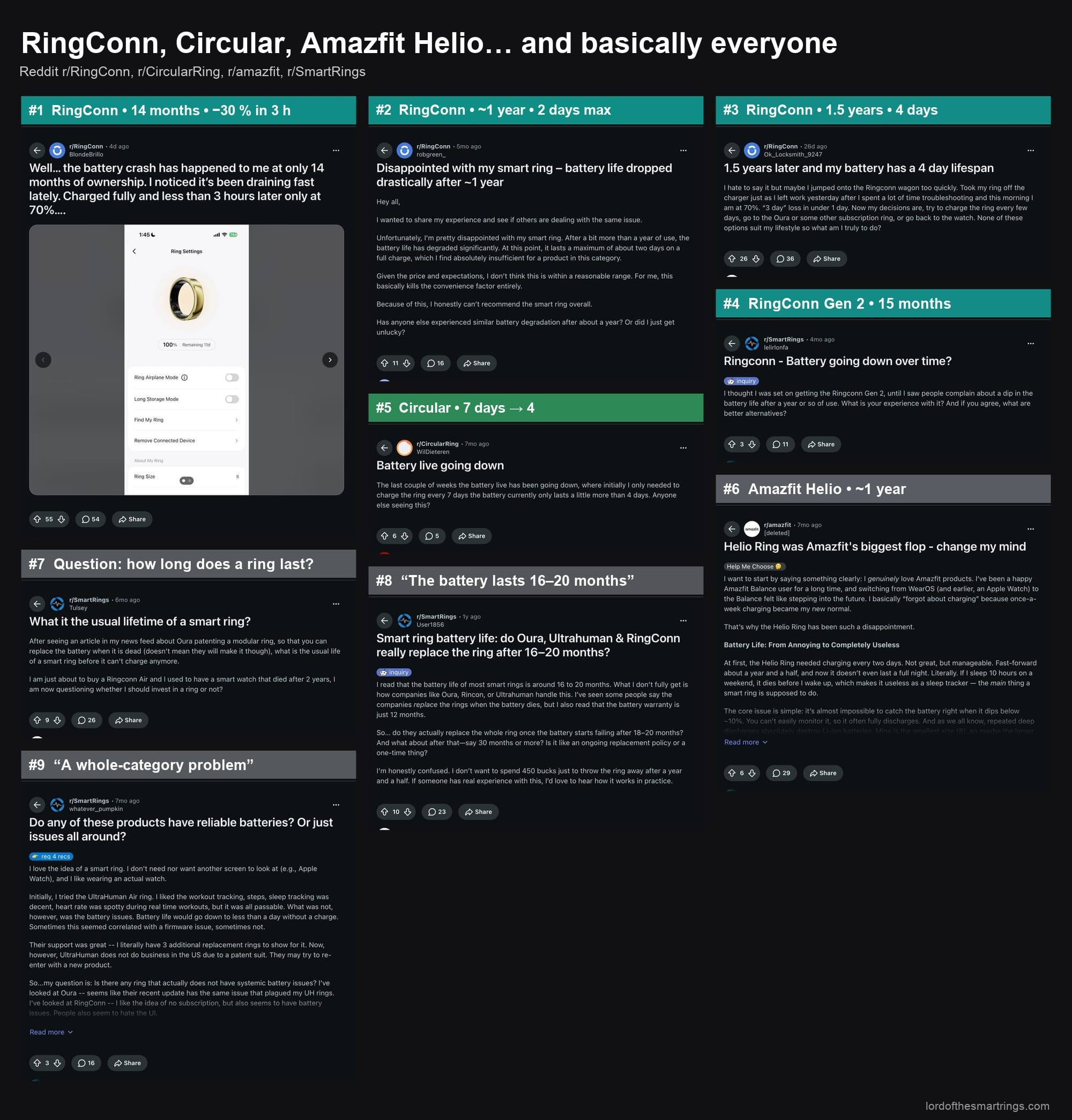
RingConn has battery life I've praised many times. The Gen 2 easily lasted 10+ days. But even RingConn can't escape the battery crash after 12–14 months, sometimes as early as month seven. Circular? From 7 days down to 4. And the Amazfit Helio? After a year, one thread called it "Amazfit's biggest flop". I think it's the same effect as with Samsung: the first ring in the brand's ecosystem. The Helio is a very good ring, but its battery life was weaker from the start, around four days, and then it shrank to a couple of days.
That's simply the reality of where smart ring technology is today. Not one brand failing, but the battery tech in rings.
Sources: #1 · #2 · #3 · #4 · #5 · #6 · #7 · #8 · #9
What do the brands say?
They're covered, of course. Oura, RingConn and Ultrahuman all have similar wording in their terms: the battery is a consumable and normal battery ageing isn't covered by the warranty. Oura offers a recycling program, but without a discount on a new ring. There's no official trade-in.
Sources: Oura – Warranty FAQs · Ultrahuman – FAQ · RingConn – Can a Smart Ring Battery Be Replaced? · Trustpilot – Oura · 9to5Google – Galaxy Ring
And the EU? From 18 February 2027 the Batteries Regulation requires batteries in portable devices to be user-replaceable. I'm afraid, though, that rings will slip through the exemption for devices designed to be used in water. We'll see.
🧯 2. A swollen battery on your finger
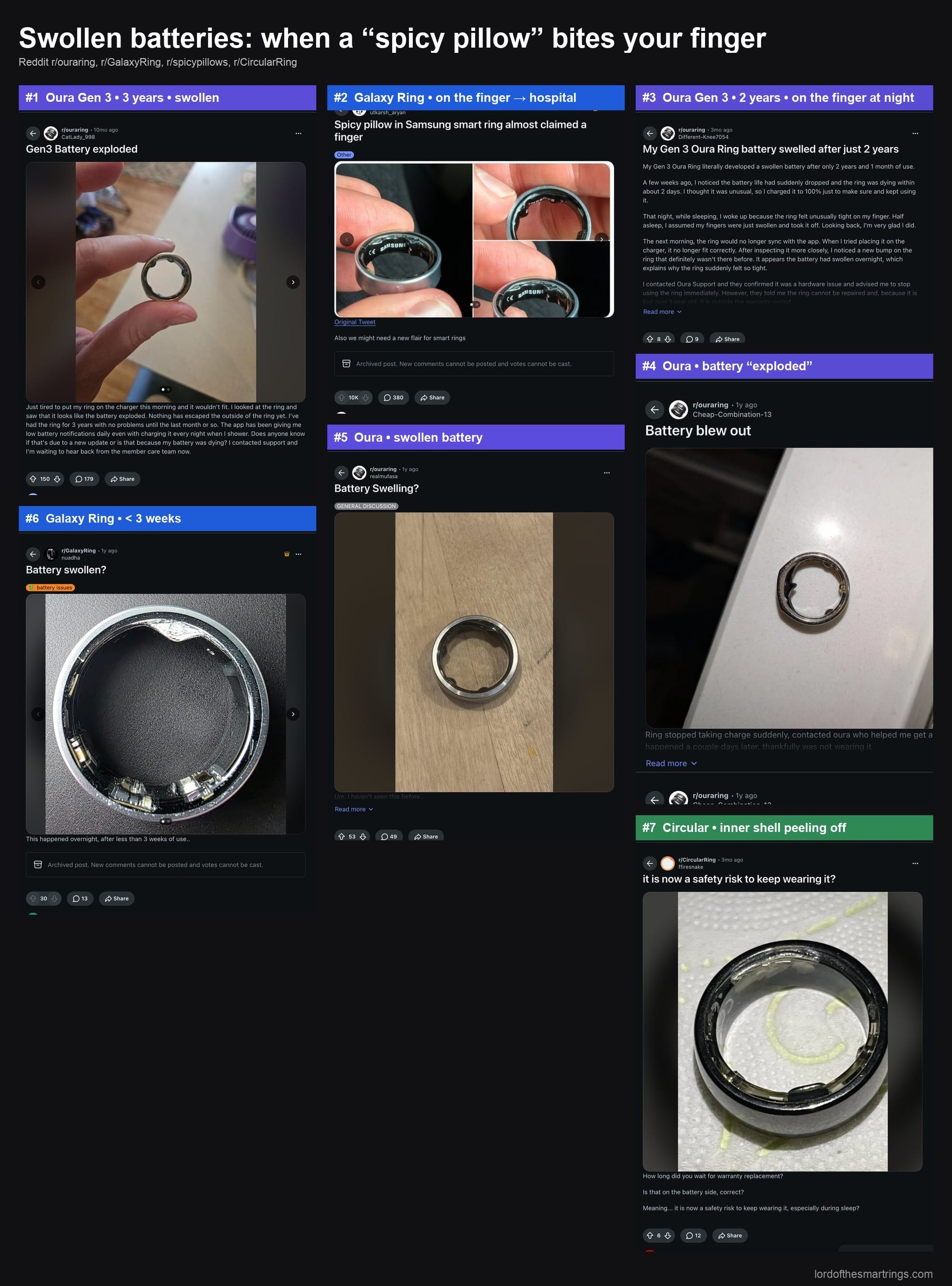
Let's stay with the battery for a moment. I didn't plan this section, but the research surprised me. At the end of its life (or sometimes earlier) a lithium battery can swell. Reddit calls it a "spicy pillow". On a phone, the back bulges out. On a ring, the battery expands inwards, into your finger, because often only the outer shell is metal.
The best-known case happened at an airport: a tech creator's Galaxy Ring (@ZONEofTECH) started swelling right on his finger. You can't fly with a swollen lithium battery, so the flight was off and the trip ended in a hospital, where they removed the ring using ice and lubricant. After its investigation Samsung said it was a crack in the inner moulding and not a wider safety risk.
Cracks in the inner shell, by the way, are a phenomenon across brands. I've seen it myself on a RingConn Gen 2, on a Circular and on a Niceboy. And in December 2025 r/ouraring saw a wave of swollen Gen 3 rings, usually after two or three years. One post describes waking up in the middle of the night because the ring was "somehow pressing more".
Sources: #1 · #2 · #3 · #4 · #5 · #6 · #7
The lesson: if your ring suddenly starts draining fast or stops sitting properly on the charger, I'd be careful about putting it on at all. Take it off, stop charging it, and check the inner side for cracks.
📏 3. Size: choosing it, and the fact that your finger isn't a constant
a) Picking the right size is a science
Smart rings aren't sold in jewellery sizes, and even if they were, it might not help much. Every brand has its own size chart and usually a sizing kit, a set of plastic dummy rings to try on.
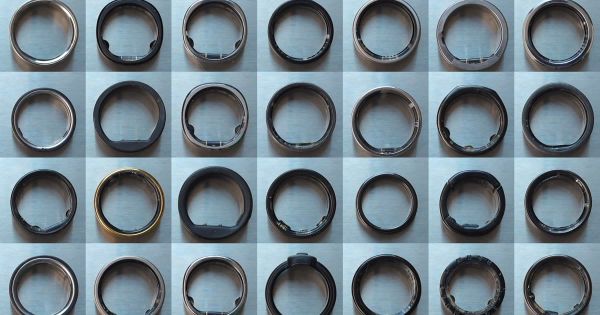
I wrote a separate guide to choosing the right smart ring size. It deserves an update, but the principles still hold. And if you want to see how different "size 9" really is between brands, check my smart ring database with 28 hand-measured rings.
b) Your finger changes
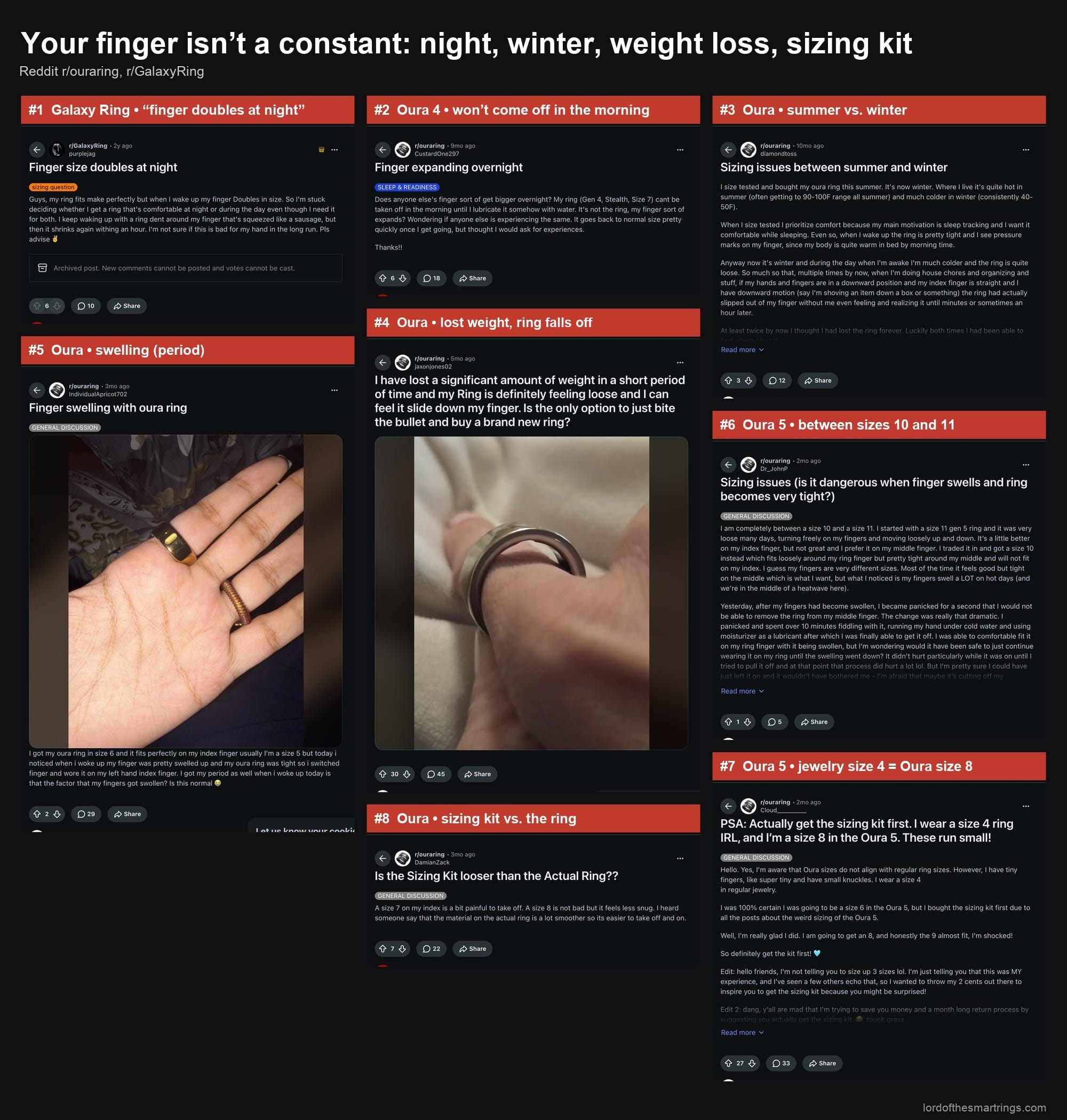
Finger circumference fluctuates during the day (it's usually more swollen in the morning than in the evening), with temperature (in winter the ring slips off, in summer it squeezes), with salt and alcohol, with your cycle, on a plane, when you lose or gain weight. A normal ring you just take off. A smart ring is unusually wide and thick, and it can be a real problem to get it off.
That's why size matters so much. A ring that's too loose spins and measures nonsense. A ring that's too tight sometimes won't come off.
Sources: #1 · #2 · #3 · #4 · #5 · #6 · #7 · #8
c) A stuck ring
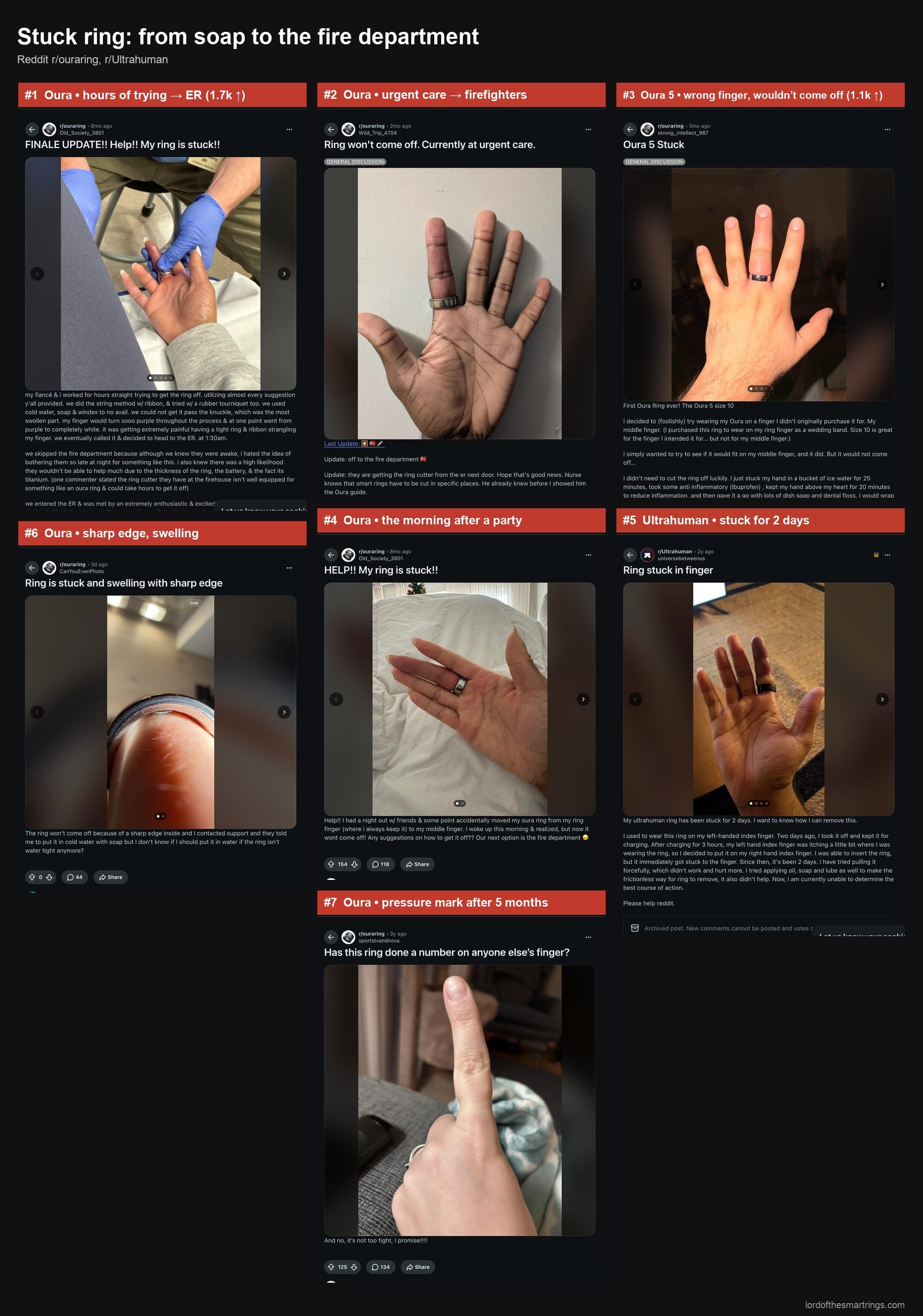
I've been there myself. I came home late, not exactly in top form, and before going to sleep I just wanted to put my smart ring on so I wouldn't miss that precious data. I mixed up the fingers and put it on a different one. In the morning there was swelling, and you get nervous pretty quickly wondering how to get it off. In the end soap did the trick.
You're not alone. The thread "FINALE UPDATE!! Help!! My ring is stuck!!" has over 1,700 upvotes on r/ouraring: hours of trying with soap, string and ice, a purple and then white finger, and finally the ER at 1:30 a.m. Another thread went from urgent care all the way to the fire department and their ring cutter. A smart ring has to be cut in specific places so you don't cut into the battery. Fun detail: when Ultrahuman launched the Ring PRO, they mentioned a section designed to be easier to cut through, precisely to help firefighters.
Sources: #1 · #2 · #3 · #4 · #5 · #6 · #7
Any ring also carries the risk of so-called ring avulsion: the ring catches on something (a pull-up bar, a fence, a car door) and tears the soft tissue. A smart ring is also wider and thicker than a wedding band. Avulsion sounds horrible and I hope nobody reading this has any experience with it.
💸 4. Price: purchase price + subscription + a two-year life
Here's the main consequence of point 1. A smart ring's price stops making sense once you divide it by its expected lifespan. Let's do the maths (prices from the official US stores in November 2026, Oura 5 at launch price):
| Ring | Price | Subscription / year | Total for 2 years | Per year |
|---|---|---|---|---|
| Oura Ring 5 | $399–499 | $69.99 | $539–639 | $270–320 |
| Ultrahuman Ring PRO | $479 | $0 | $479 | $240 |
| Samsung Galaxy Ring | $399 | $0 | $399 | $200 |
| RingConn Gen 3 | $428 | $0 | $428 | $214 |
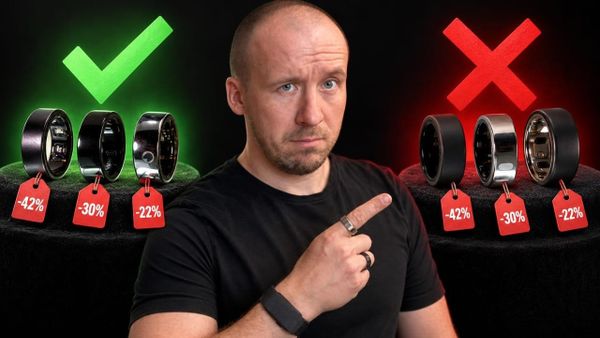
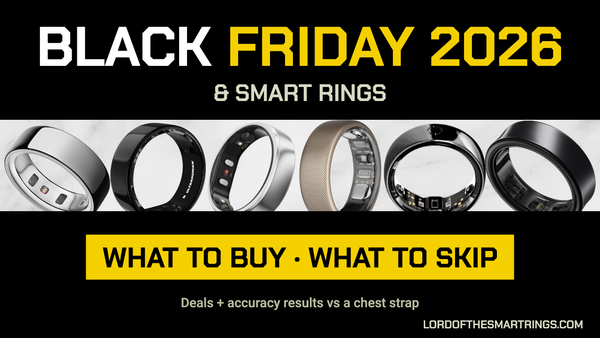
Roughly $200–320 a year just for something on your finger measuring your sleep. For that money you can buy a decent sports watch that will last, I dare say, many years. And if you're shopping anyway, at least wait for a deal: I keep an updated list of Black Friday smart ring deals.
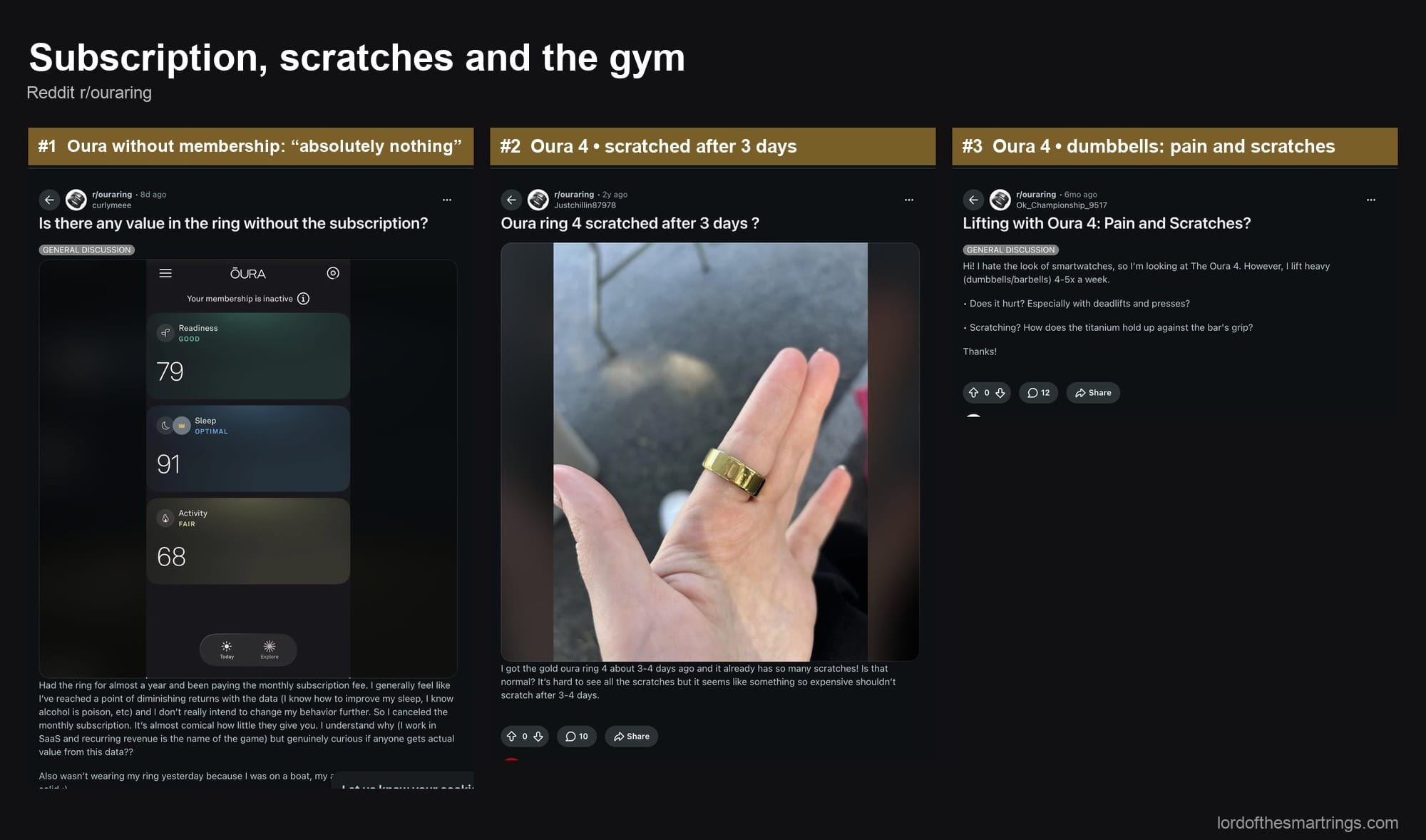
The Oura subscription is a chapter of its own. Without the membership ($5.99 a month) you only see the bare scores, which feels very thin to me. When someone asked on r/ouraring whether the ring has any value without the subscription, the top answer was "Absolutely nothing." Oura CEO Tom Hale defends the subscription by saying it funds the continuous development of new features. Fair enough. It's just that the hardware could then last longer than the software you keep paying for.
🔬 5. Level of detail: a ring is not a workout tracker
A ring is brilliant for sleep and resting heart rate. As soon as you start moving, accuracy drops fast. And it's not only about how accurately a ring measures, but how often it measures at all.
I saw it in black and white in my Oura Ring 5 vs. chest strap test:
- at rest, great agreement with the strap (MAE 1.6 bpm, correlation 0.90),
- during the day at rest, Oura measures only once every 5 minutes, during a workout roughly every 5 seconds,
- during normal movement without a started workout there can be gaps of over an hour without a single reading.
Steps turned out similarly in my step accuracy test, and I compared the night heart rate of eight rings in a separate test.
😵 6. Scores, scores, scores: welcome to orthosomnia
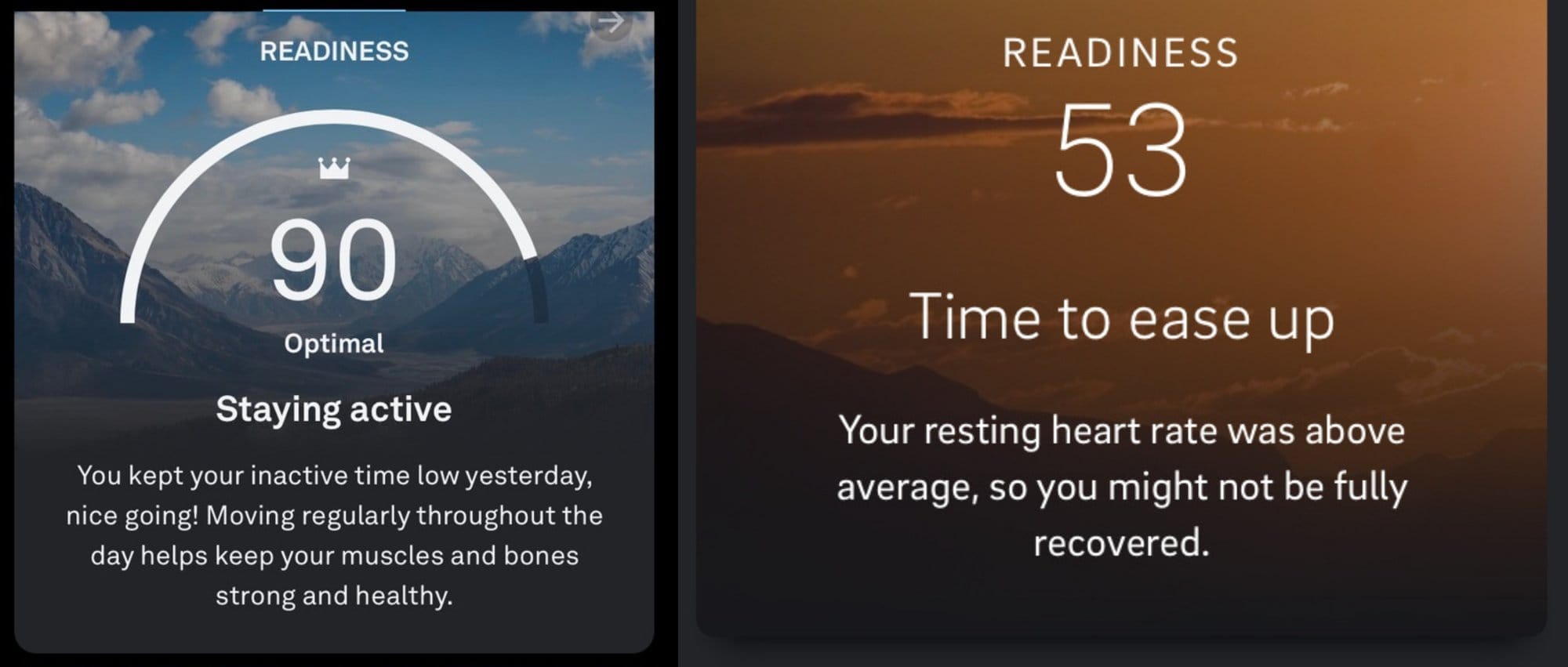
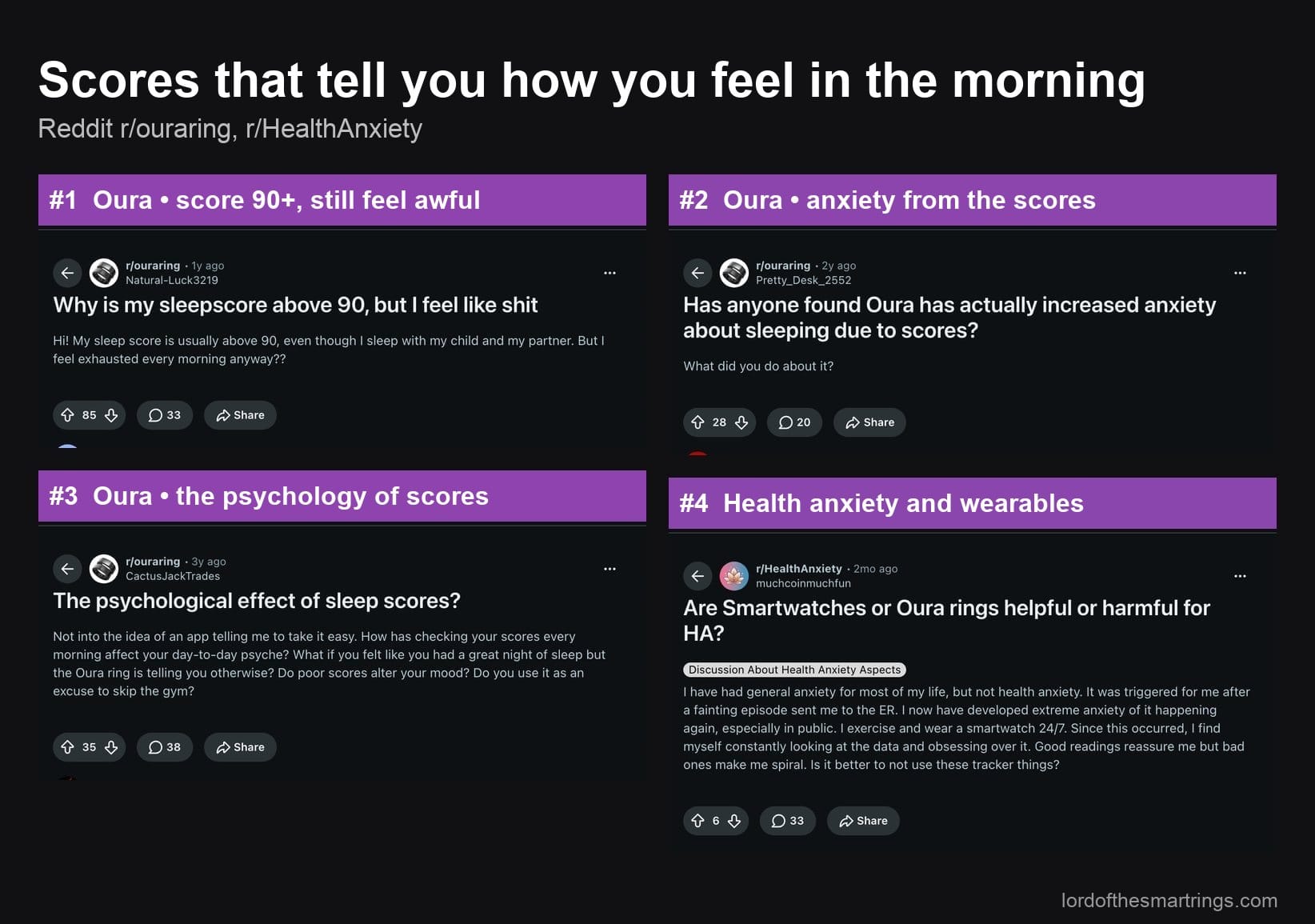
I have a feeling this whole thing was started mainly by smart rings, and Oura in particular. Every morning the ring announces a number. Readiness 53, "Time to ease up". Or 90 and a little crown. And that's where a problem begins that even has a name: orthosomnia. The term was coined in 2017 by sleep physicians in the Journal of Clinical Sleep Medicine, when patients started coming to them not with a sleep disorder, but with an obsession with perfect data from their sleep tracker. Chasing better numbers became the problem itself.
There's also a beautiful experiment on the power of suggestion. In an experiment from 2014, researchers randomly "measured" that participants had slept above or below average. The measurement was made up. Those who were told they slept badly then did worse in attention and memory tests. Just the information about bad sleep made their performance worse. Now imagine getting that on your phone every single morning.
I wrote a whole article about orthosomnia. And whether the apps at least give you the same advice, I tested in one day with Oura, Ultrahuman and RingConn.
➕ And a few more reasons I sometimes hate rings
🏋️ 7. The gym and scratches
A ring is not a good gym buddy. It's wide, it gets in the way when you grip dumbbells or a barbell, and it gets scratched. A gold Oura 4 "scratched after three days" is a Reddit classic, and of course the warranty doesn't cover scratches. I personally count on scratches, but some people are really sensitive about it. And when the ring rotates, the sensors aren't where they should be, so the measurement gets shady too.
🗑️ 8. Unrepairable = e-waste
Back to the battery for a second. It can't be replaced, so every two years you throw away the whole ring, sensors and all, sensors that would happily keep working. That's just rubbish, and you get a piece of e-waste every two years. According to reports, Oura has patented a modular ring with a replaceable battery. I just hope it won't stay a patent, although I'm not sure a replaceable battery is a good business case for them. It's the same big debate we've had about phones and watches.
🎰 9. The warranty lottery
How your claim ends up sometimes depends on what the diagnostics show, which support agent (or AI chatbot) you get, and which country you live in. Someone gets a new ring even after two years plus three months of free membership. Someone else gets only a discount after 18 months. Ultrahuman users also complain that critical posts disappear from the official subreddit (I haven't verified it, but several people say so independently).
🏢 10. Companies, patents and the cloud
A ring without its app is just expensive jewellery. And what if the company goes under, or gets banned from selling? That's not just theory. Because of the patent dispute with Oura, Ultrahuman hasn't been allowed to sell in the US since October 2025. Movano's Evie Ring was pulled from sale in 2024. I have rings here whose companies basically don't exist anymore. Circular is still catching up on promised features. And in the summer of 2025 a wave of data worries went around Oura and the US Department of Defense. Oura explained it doesn't share consumer data with the military, and the Palantir rumours were debunked by Snopes.
What I want to say: you buy a ring, and in a year or two the company may not exist, because someone else sued it. That can happen in other consumer electronics too, but in the young smart ring segment a lot is going on, and it's fascinating to watch. I might do a separate piece on the patents: who bought what from whom and who copies whom. I just hope Oura won't sue me afterwards.
⌚ 11. You still need a watch (?)
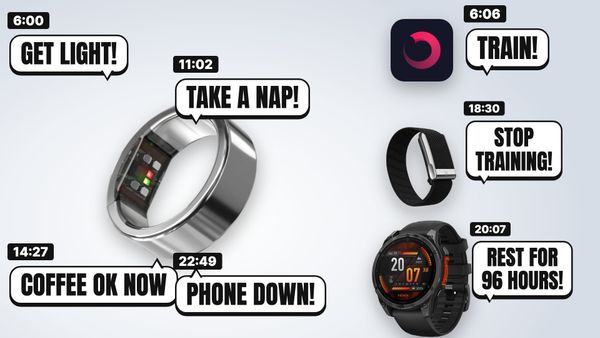
No display, no GPS, weak heart rate during sports. If you do sports, you'll almost always wear a watch as well. So you're not paying instead of a watch, but on top of it. It depends on your use case and how active your life is, but it's good to count with it.
🔍 Bonus: it's easy to lose
A ring is small. You put it down by the sink, in a pocket or on the nightstand, and it's gone. Finding it in the app usually only helps within Bluetooth range, and only while the ring still has battery. I've walked around my flat looking for a smart ring more times than I can count. In the end, my wife always finds it.
🏁 So why the hell do I still wear them?
Because for what they were made for, they're still the best. Sleep, resting heart rate, HRV, temperature, all very discreetly and without a watch getting in the way at night. I just think their dark side should be talked about more loudly. Especially the battery.
If you're buying a ring, here are a few tips from my experience and from all the research:
- count on about two years and work out what the ring really costs you per year,
- keep your receipt and get a battery diagnostic done around month 11 (in the EU around month 23), while you're still under warranty,
- pick your size in the morning, not in the evening, and wear the sizing kit for at least 24 hours,
- take the ring off before the gym; to keep your heart rate data, you can use an external source such as a chest strap or your watch,
- be careful about which finger you put it on when you come home from a party,
- if it gets stuck, don't panic: soap and slowly twisting it round and round usually works (there's also a trick with a string, it didn't work for me, but maybe you'll be handier),
- if the ring drains quickly or doesn't sit properly on the charger, stop wearing and charging it.
Now it's your turn. How long did your ring last before the battery died? Has a smart ring ever got stuck on your finger? And would you go back to a ring after it disappointed you? Let me know in the comments. I believe the technology is still in its infancy, and I hope the battery problem in particular gets solved.
❓ FAQ
How long does a smart ring battery last?
Realistically about two years. After that the battery fades fast and can’t be replaced, so the whole ring dies.
Does the warranty cover a weak smart ring battery?
Oura, Ultrahuman and RingConn all treat the battery as a consumable. The warranty is 1 year (2 in the EU) and a replacement after warranty is goodwill, not a right.
What should I do if my smart ring gets stuck on my finger?
Don’t panic, use soap and slowly twist the ring round and round. It’s best to take the ring off before the gym.