Step Accuracy 2026: Oura 5 vs Ultrahuman PRO vs RingConn Gen 3 — the (un)surprising winner 👣
Three of the newest smart rings, a scientific ankle pedometer on my leg and 20 days of real-life walking. Which one gets closest to reality? And why do all three (SPOILER!) count fewer steps than you actually take?

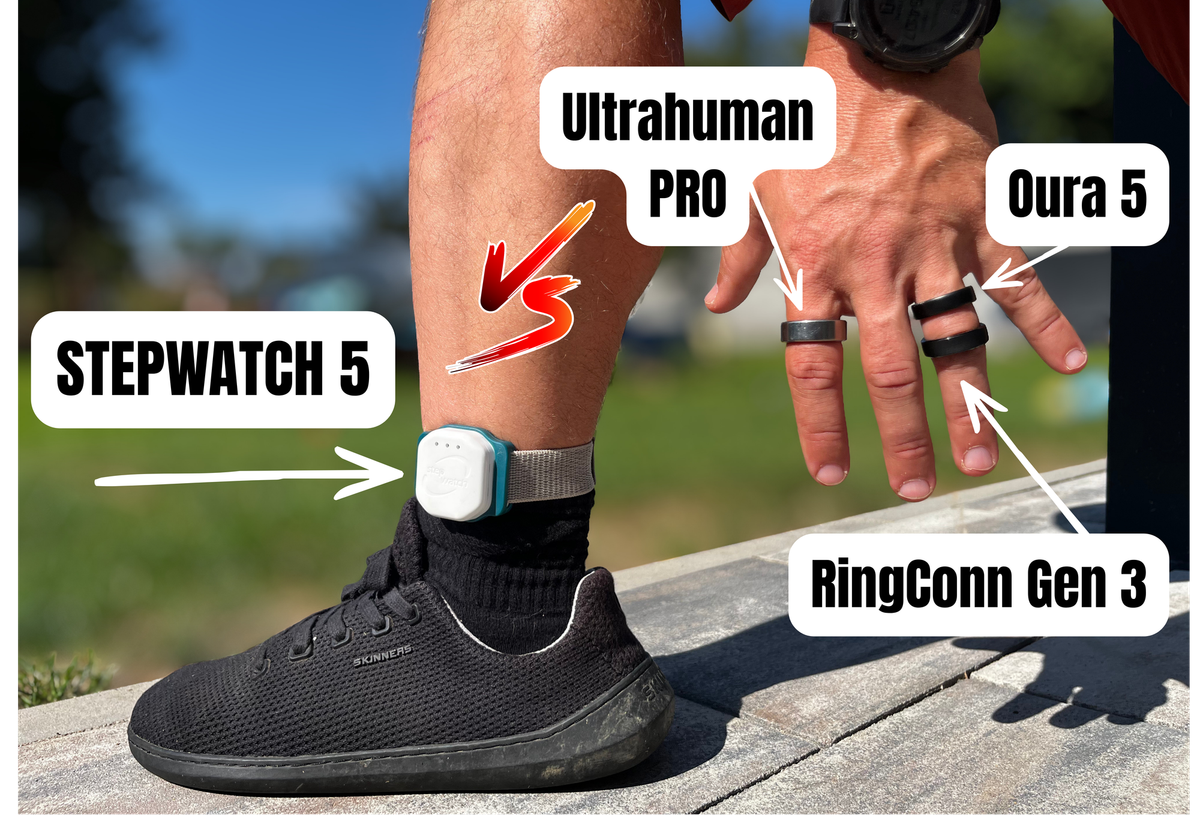
A year and a half ago I compared step counting across nine smart rings. Since then the whole top has been replaced — Oura shipped its 5th generation, Ultrahuman the Ring PRO and RingConn the Gen 3. So I pulled the StepWatch 5 ankle reference back out of the drawer and gave them another shot at guessing your steps from your hand / fingers .
 LORDoftheSMARTRINGS
The methodology is the same as last time, but let me step through it once more.
🤨 Why most step tests tell you nothing
Before I get to the numbers, I need to get one gripe out of my system. Google “smart ring step accuracy” today and you’ll almost always land on one of two formats. Both share the same flaw: they have no reference. Or more precisely — no correct reference. And when they do have one, something else is missing: real life.
Format one: ring versus watch
The reviewer puts on a ring and a smartwatch, goes for a walk and compares two numbers. Or frames it as “the truth is somewhere between Whoop, Apple Watch and Garmin”... :)
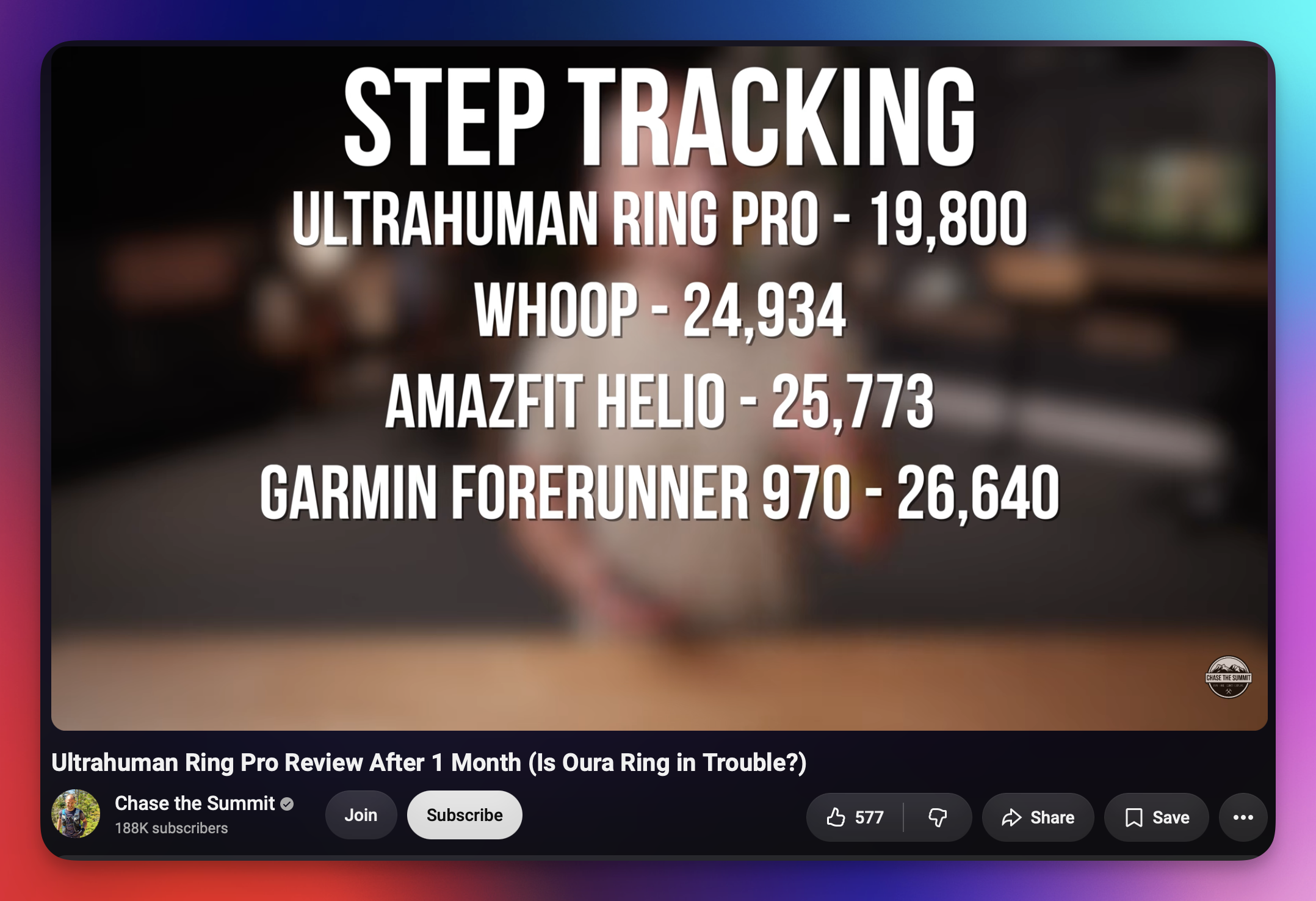
The problem? A watch on your wrist isn’t a reference. It’s just a second guess from an equally unsuitable spot. Both devices estimate steps from arm movement — and when two guesses agree, that doesn’t make them right. It makes them wrong in the same direction.
Format two: count 5,000 steps and compare
A slightly more honest version: the reviewer grabs a mechanical tally counter, goes for a walk and clicks every single step by hand. Android Central did exactly that across the whole smart ring lineup and the results looked superb — over 5,000 steps the Galaxy Ring was off by 11 steps, Oura by 12, Helio by 8.
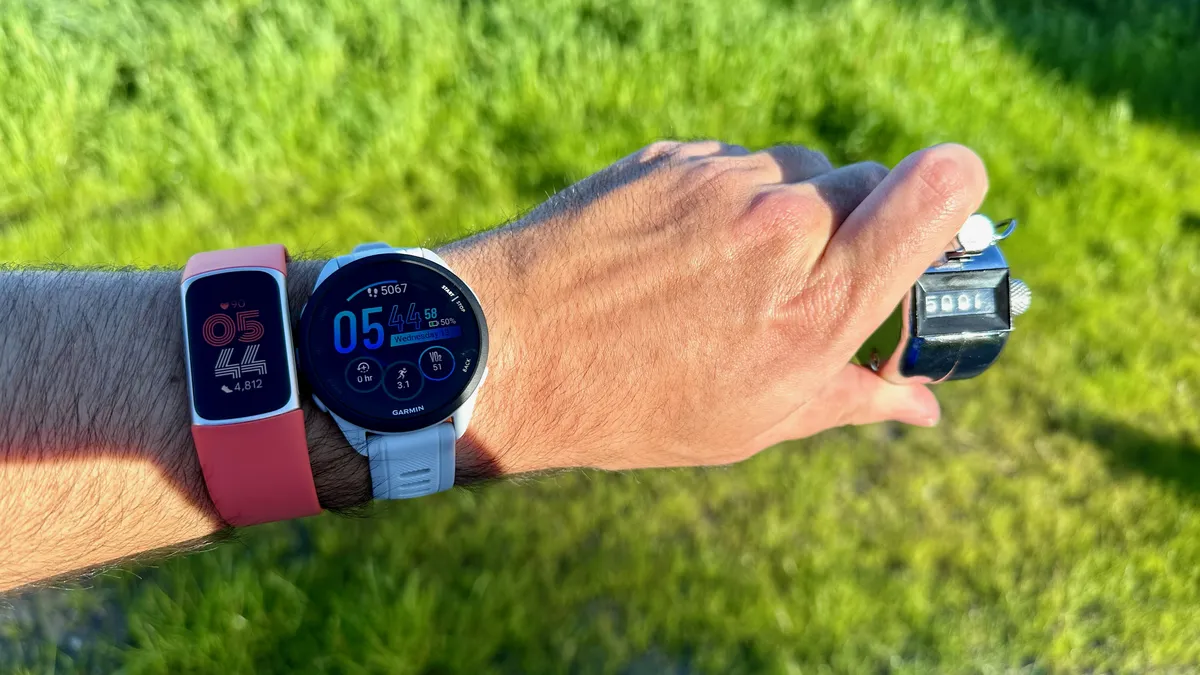
Except this test measures the one and only situation in which everything works: focused, uninterrupted walking with free hands and a steady cadence. That’s not an ordinary day in the 21st century. That’s a lab condition. Manufacturers must be delighted with a test like that.
The funniest — and most honest — part is that the very same article debunks itself a few paragraphs later. The author describes how the rings pile up hundreds to thousands of phantom steps a day while he is merely sitting at a computer, cooking, or gesturing during a conversation. A 5,000-step test will never catch that — and yet that’s precisely what ends up in your app. The job of a step algorithm is to count steps and filter out the noise around them.
So I did my best. And the only correct setup is:
- 🦵an ankle-mounted reference,
- ⌛ a long enough period — 20 days in my case,
- 🤺 varied, real-world activities.
🥼 How I measured it
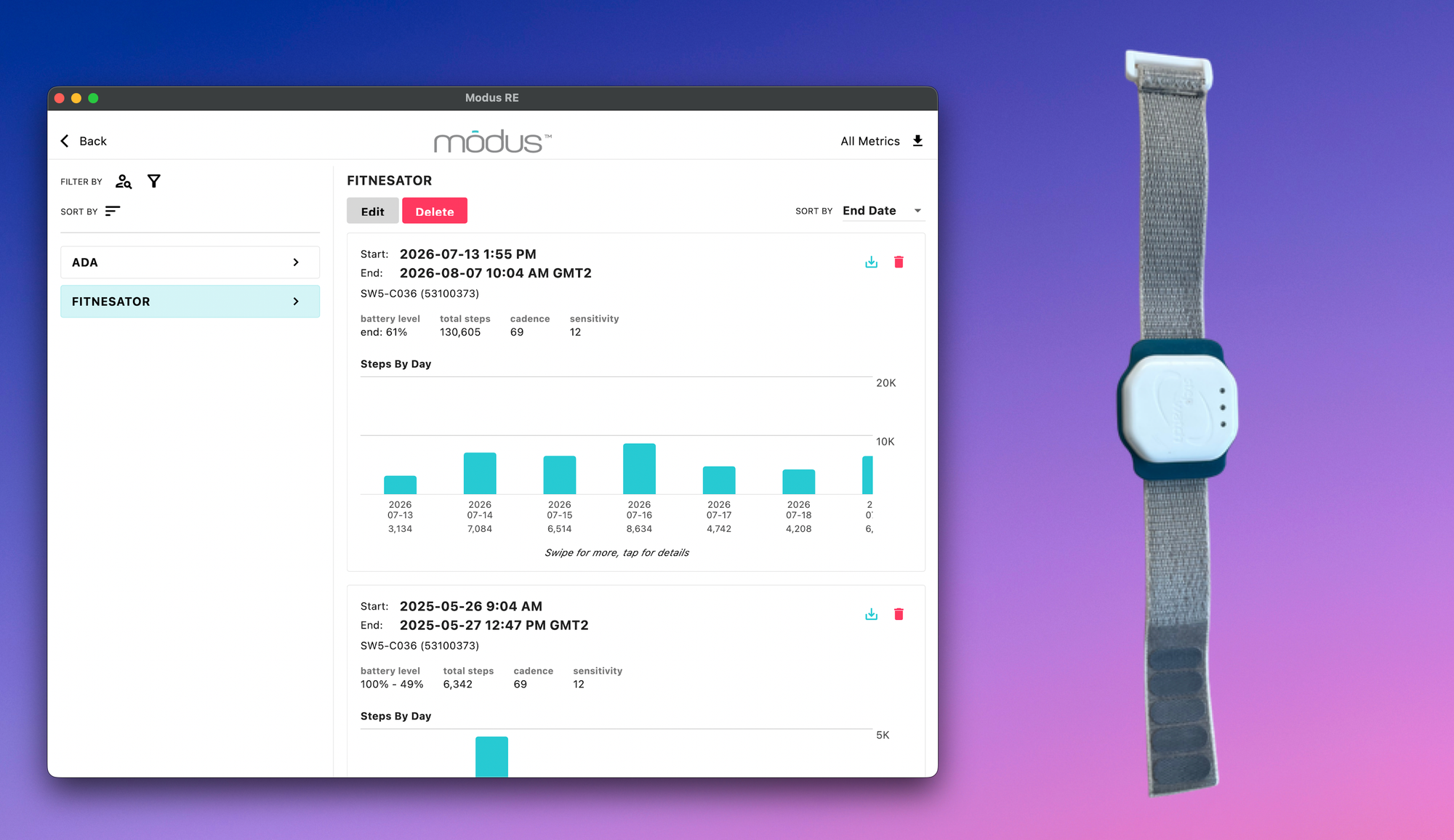
The reference is once again the StepWatch 5 — a clinical pedometer from Modus Health worn above the ankle and widely used in scientific studies. Its accuracy sits between 96% and 99% even in people with an irregular gait, which is a bar no consumer wearable gets anywhere near.
One technicality: the StepWatch records the steps of a single leg. It’s worn on one ankle and counts the stride rate of that limb. To turn that into steps in the everyday sense, the daily value has to be multiplied by two. A wearable does this inside its own algorithm anyway — otherwise your 10,000-step goal would really only be 5,000... :)
So I wore, in parallel:
- 🦶 StepWatch 5 on my left ankle (reference)
- 💍 Oura Ring 5 on my left ring finger
- 💍 Ultrahuman Ring PRO on my left index finger
- 💍 RingConn Gen 3 on my left ring finger
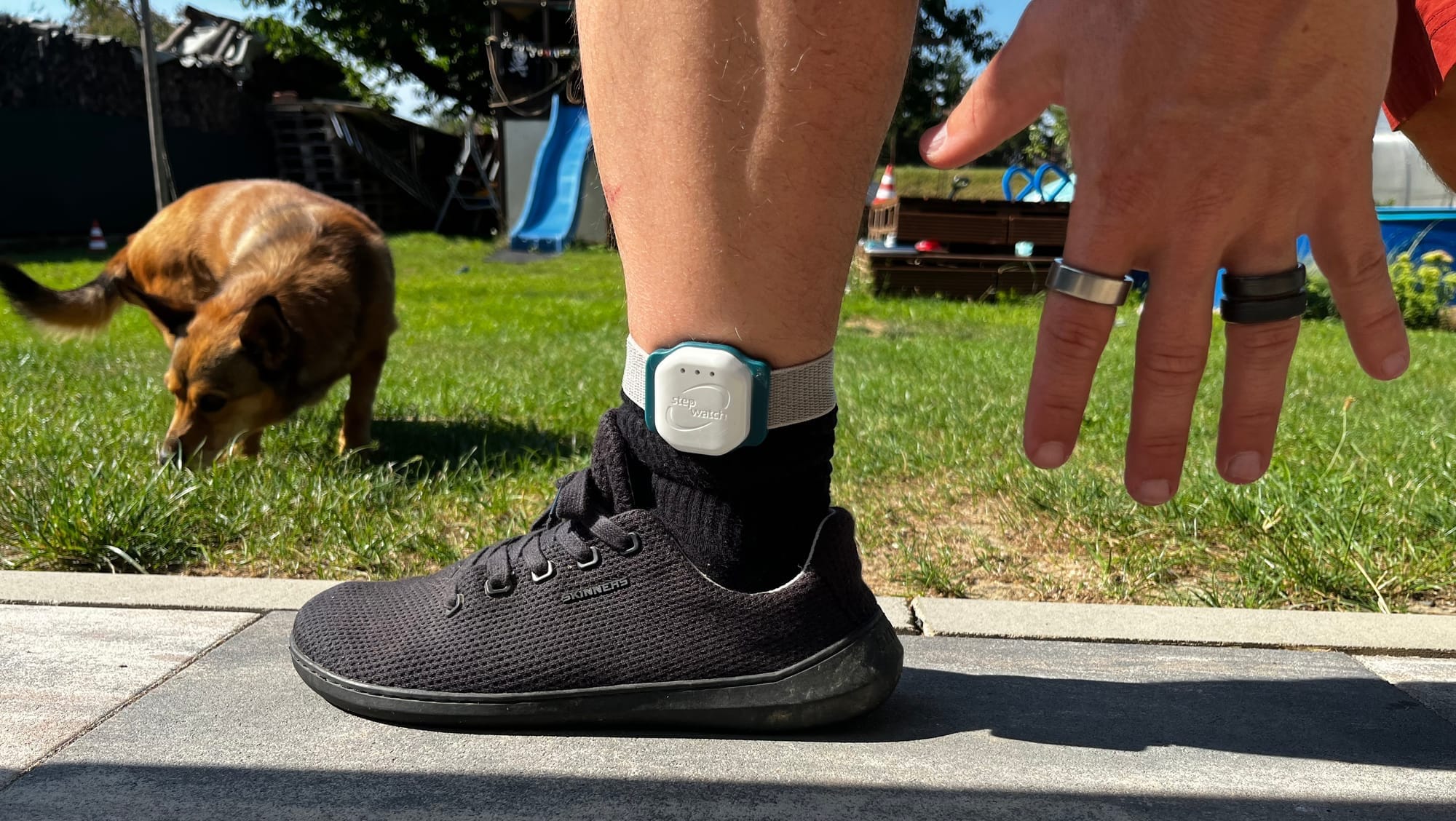
Period: 13 July – 1 August 2026, i.e. 20 days without a single gap. Ordinary life — no pushing a stroller, no scrolling while walking, no under-desk treadmill, nothing that would artificially and heavily penalise a wearable. The spread came out nice and wide: from 1,348 steps on the laziest day to 30,298 on the busiest.
📈 Results
We’re tracking two things. Correlation — how faithfully the ring follows the reference’s trend (1.0 = a perfect match) — and deviation, i.e. how far off it lands on an average day.
| Ring | 🔗 Correlation | 📊 Deviation | 📏 Abs. deviation | Total steps |
|---|---|---|---|---|
| RingConn Gen 3 | 0.98 | 23% | 2,480 steps | 179,639 |
| Oura 5 | 0.96 | 31% | 2,936 steps | 170,002 |
| Ultrahuman Ring PRO | 0.90 | 45% | 5,215 steps | 118,135 |
| StepWatch 5 (reference) | — | — | — | 222,440 |
A second angle: on how many of the twenty days was each ring closest to the reference?
| Ring | Closest to the reference |
|---|---|
| RingConn Gen 3 | 12 of 20 days |
| Oura 5 | 5 of 20 days |
| Ultrahuman Ring PRO | 3 of 20 days |
And if you’ve had enough numbers and prefer curves, here is the whole period day by day:
Daily steps · 13 July – 1 August 2026 · reference: StepWatch 5 (ankle, values × 2)
Tap a device name to hide or show its curve. Hover a point for the exact value and its deviation from the reference.
📉 They all count fewer. A lot fewer.
The most interesting number in the table isn’t the correlation — it’s the last column. Over twenty days the StepWatch says I took 222,440 steps. RingConn counted 179,639, Oura 170,002 and Ultrahuman 118,135.
That’s a systematic undercount of 19%, 24% and 47%. Not one of the rings inflates your steps — they all lose them, just at wildly different rates.
Why does this happen? A ring estimates steps from an accelerometer on your finger, which is one of the worst possible places for the job. Walk with a hand in your pocket, carrying a bag, holding a phone to your ear or pushing a shopping cart, and the hand barely moves — so the ring has nothing to count. The StepWatch on your ankle has no such problem: the leg always moves.
The practical impact? If your ring shows 8,000 steps, you’ve most likely actually done 10,000 (RingConn), 10,500 (Oura) or nearly 15,000 (Ultrahuman). That 10,000-step goal sitting in the app is considerably harder than it looks.
🥇 Winner: RingConn Gen 3
RingConn won this one outright. The highest correlation (0.98), the lowest deviation and the smallest systematic offset. It carries on from the Gen 2, which also won this test for me last time — step counting is evidently a long-term RingConn strength rather than a one-generation fluke.
Oura 5 is a solid second. A correlation of 0.96 is very good; Oura simply does worse on high-activity days — on 23 July it logged 27,183 steps against the reference’s 30,298, which is still fine, but on ordinary days it drops lower than it should.
The Ultrahuman Ring PRO is a bit of a letdown. Barely half of the real step count is a lot to miss — maybe someone at Ultrahuman forgot to multiply by two :)
🔧 Can you train the Ultrahuman?
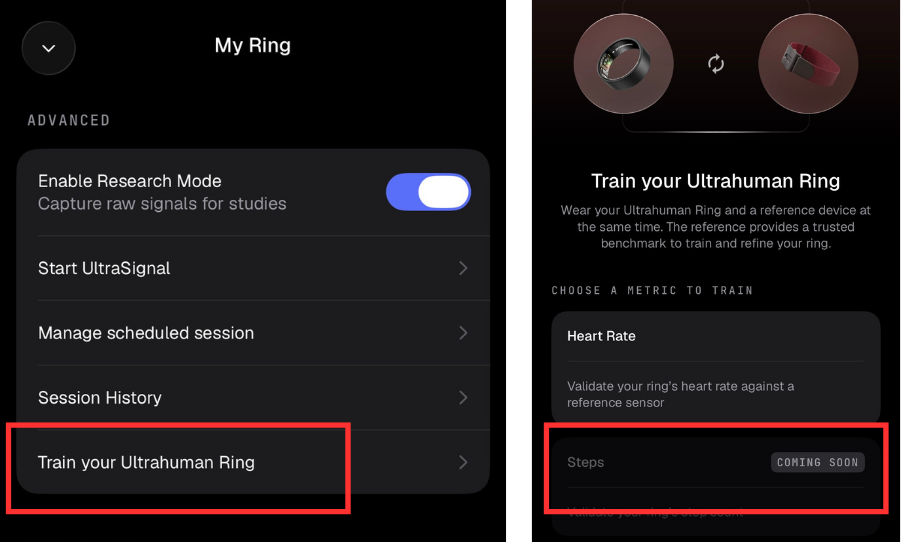
The new Ultrahuman Emerald app added the ability to calibrate the ring yourself — for now, heart rate against your own chest strap. Steps can’t be calibrated yet:
🤔 Verdict
For step counting, a smart ring is a compromise. All three capture the trend reliably, and that’s the good news. I’d take the absolute step count with a large pinch of salt — treat it as a lower bound.
If steps matter to you as a metric, RingConn Gen 3 is the clear pick of these three. Oura 5 is perfectly serviceable. The Ultrahuman PRO may be undercounting on purpose, just to make you push a little harder :)
All in all, I keep coming back to the same thought: a smart ring is a very expensive pedometer...
Which of these rings are you wearing — and does its step count match your reality? Let me know, and tell me which device you’d like me to put to the test next.