Oura Ring 5 vs a Chest Strap: 24 Hours of Heart Rate "Accuracy"
I strapped an Oura Ring 5 and a chest strap to one ordinary day — sleep, six workouts, the lot — and pulled the raw data. Here's how a smart ring actually measures your heart rate, and exactly where it goes quiet.

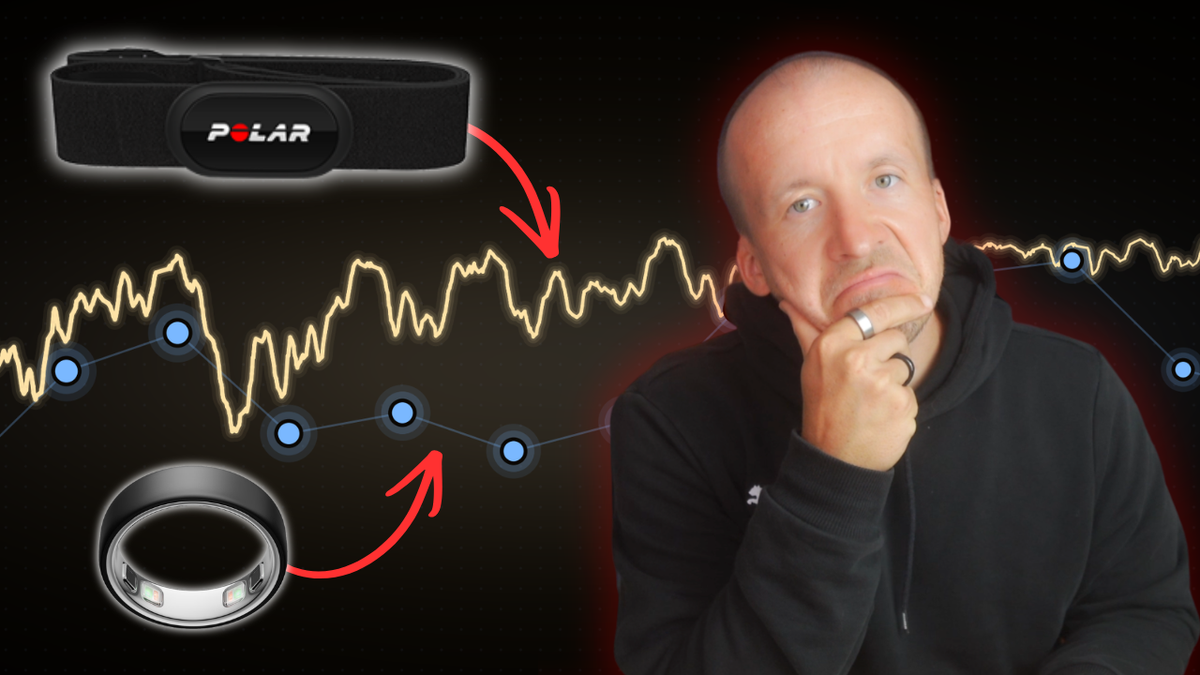
A smart ring is a supremely confident device. Every morning it serves up your lowest heart rate, your average heart rate, your HRV — and through the day it draws a neat little curve of your pulse and stress. It's easy to walk away believing you're wearing a continuous heart monitor on your finger.
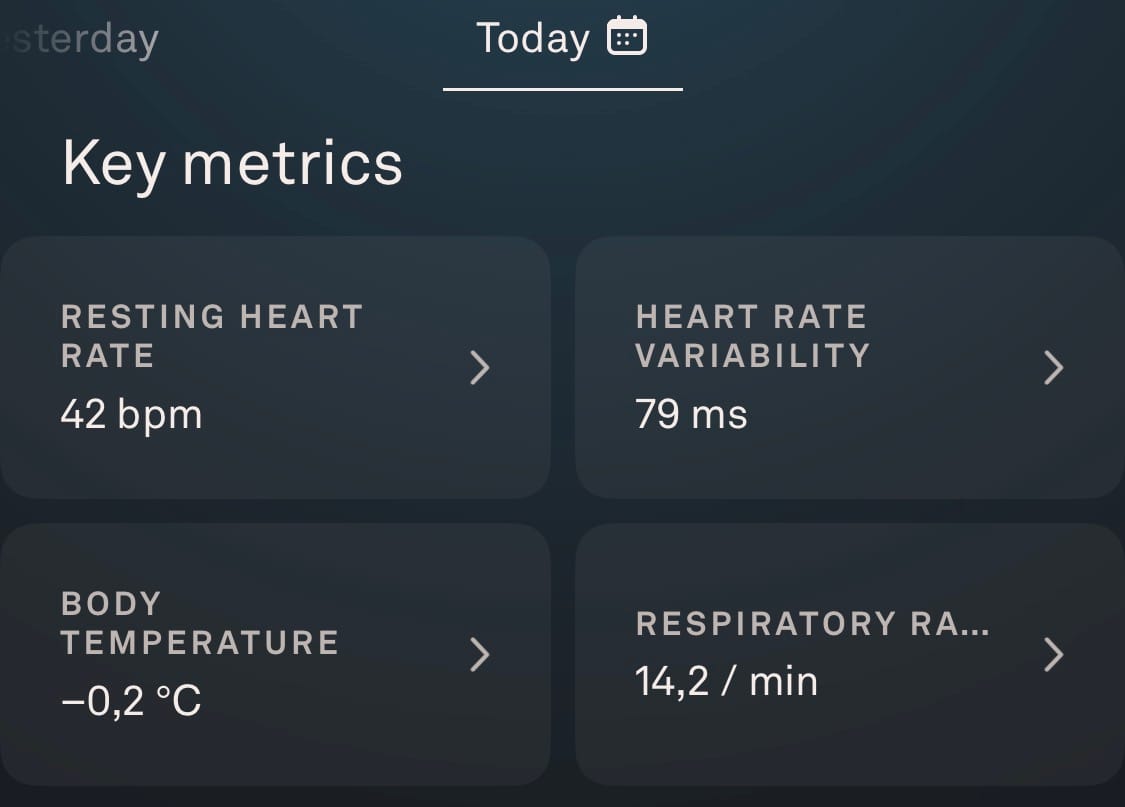
But how much does that ring actually measure in a day? And can you trust its heart rate the way you trust a chest strap?
To find out, I put the Oura Ring 5 up against a chest strap as the reference. The strap measures electrically (an ECG-style principle), beat by beat, and it's the gold standard of wearable heart rate. Oura, by contrast, leans on optical sensors that shine light through your skin.
Let's get to it. 💥
How I measured
- Reference: a chest strap, continuous recording day and night, sampling roughly every 1 second.
- Under test: the Oura Ring 5, with data pulled straight from the Oura API — the raw records, not the polished app view.
- The day: a normal day with six workouts — an overnight start the evening before sleep, squash, strength training, Halfbike, two rucking walks and an evening game of soccer.
What the data showed
Let's look at the contrast between the dense chest-strap curve and Oura's. The x-axis runs from roughly 22:00 to 22:00 the next day, the y-axis is heart rate in bpm, and I've shaded the day's workouts to make them easy to spot. First, the 24-hour trace from the chest strap.
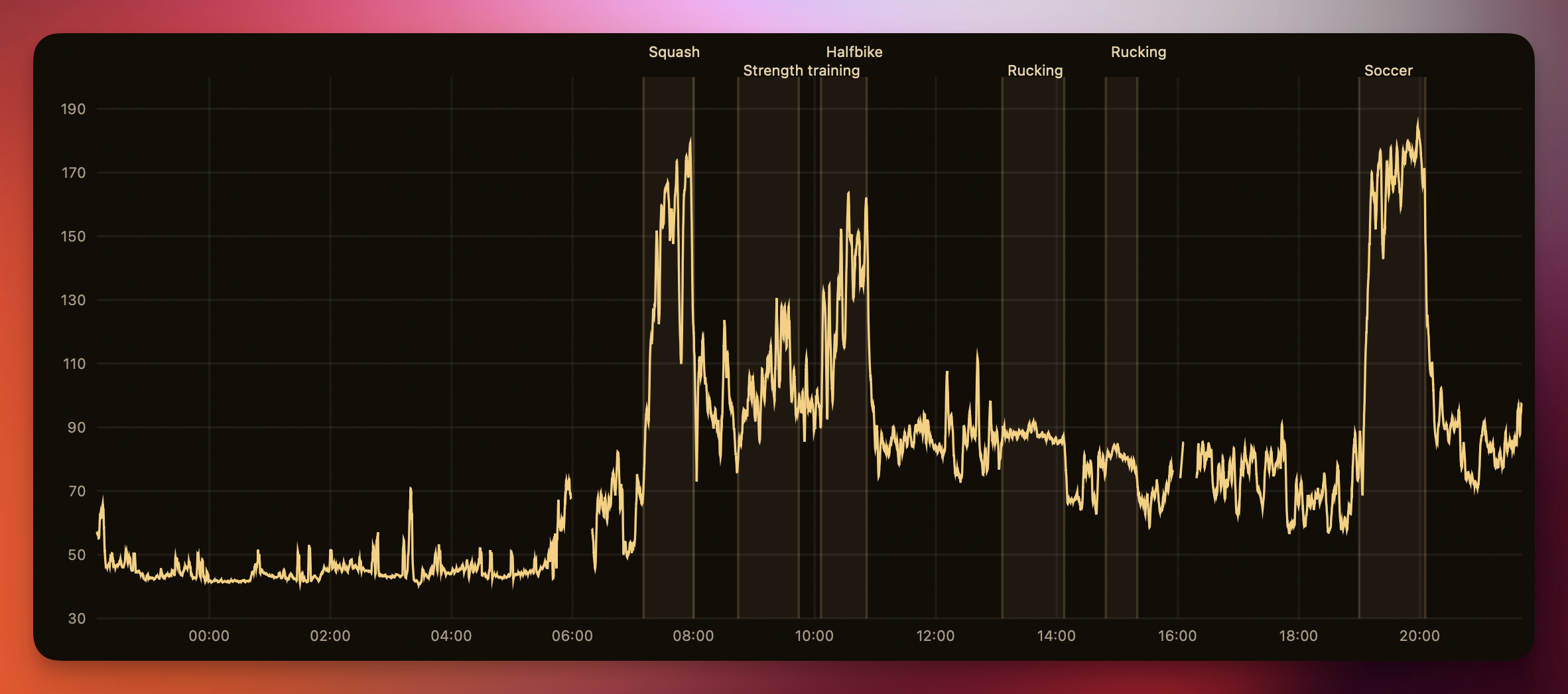
At a glance it's a near-continuous line (a couple of dropouts crept in, probably at the watch-to-strap handoff). Zoom in and it's remarkably dense — because it's built from second-by-second readings.
Now Oura. Different story entirely. The obvious difference is the density of points — and the gaps. There are so many gaps that you might question whether it's still a "curve" at all.
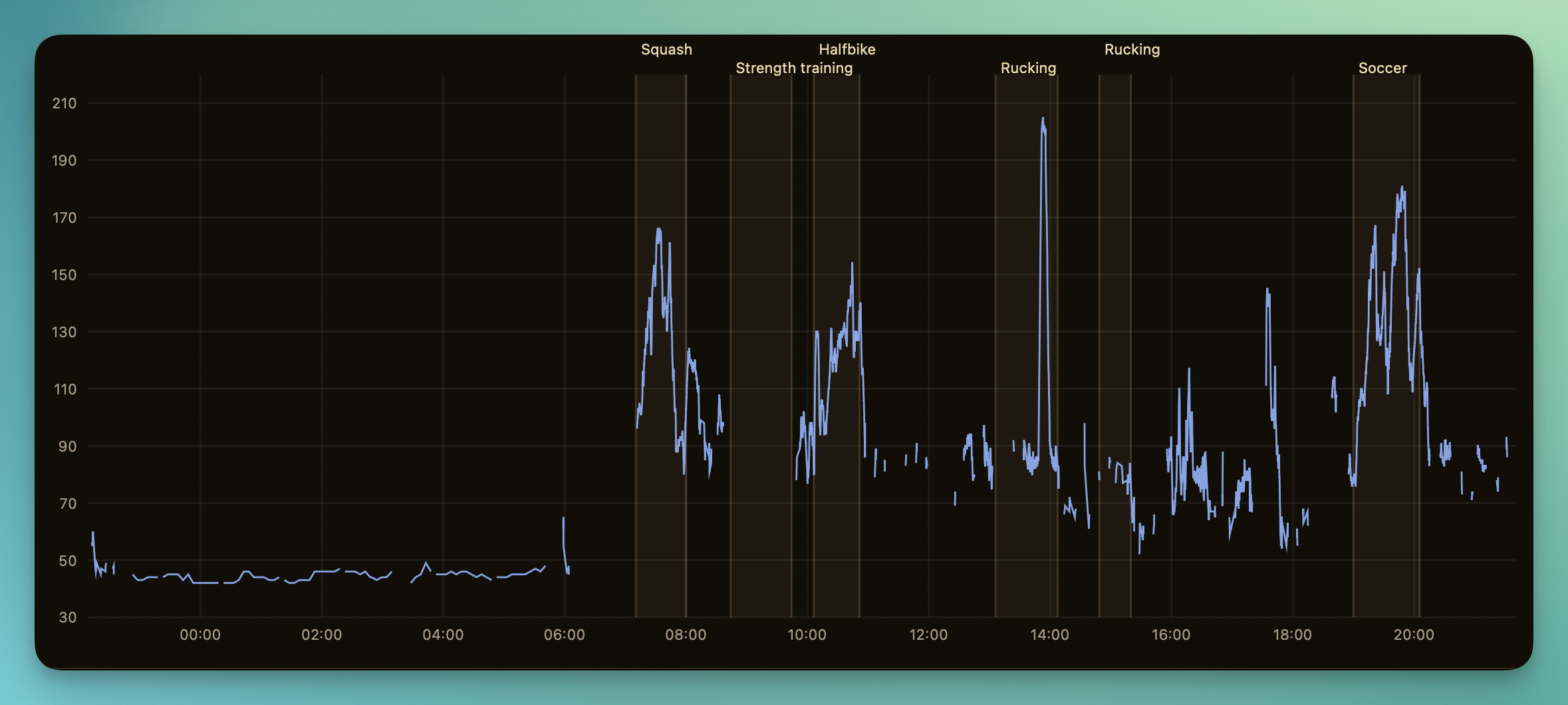
Why so many gaps? Oura dedicates an entire support section to this. The short version — Oura won't log a reading when:
- You're moving too much — the optical PPG sensor needs stillness; motion corrupts the signal, so the ring throws the reading away. This is the main cause of daytime gaps.
- Skin temperature is low or unstable (cold skin, cold weather).
- The ring is loose or the LED sensors are dirty.
- Battery is under 5% (automatic activity detection needs ≥5%).
- An activity has to last at least 10 minutes for auto-detection to log it as a workout (now I know why Oura never detected sex...).
Oura's sampling rate changes — sometimes sparse, sometimes dense
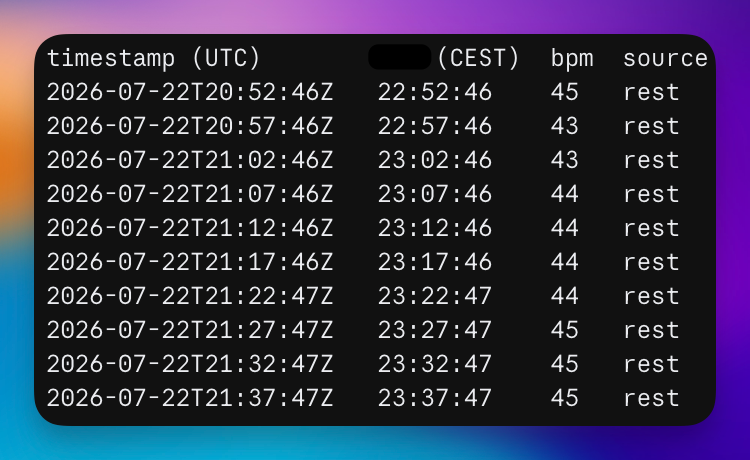
Dig into Oura's raw API data and you'll quickly notice each heart-rate reading carries a label: rest, awake, or workout. My 24-hour recording contained:
workout— 4,096 readings, one every ~5 secondsawake— 174 readings, sparserest— 84 readings, one every ~5 minutes
Here's the kicker: I never manually started a single workout in the Oura app (with one exception, more on that later). Oura decided, all on its own — through AAD (automatic activity detection) — that most of my active day was a "workout", and switched to denser 5-second sampling. The moment I settled down, it dropped back to one reading every 5 minutes. Overnight, same thing: every 5 minutes.
💡 The more you exercise, the faster your Oura 5 drains. Because the ring recognises activity and cranks up how often it samples your heart rate. Put another way: when you rest, so does your ring. 🙂
Sampling at a glance
| Source | Sampling rate | When |
|---|---|---|
| Chest strap | ~1 s, continuous | always, no exceptions |
| Oura 5 — exercise | ~5 s | only when it detects activity itself |
| Oura 5 — rest/sleep | ~5 min | under "optimal conditions" |
| Oura 5 — movement, no workout | nothing | gaps lasting over an hour |
😴 Night
At night we mostly see rest readings. First, the user-facing experience in the app:
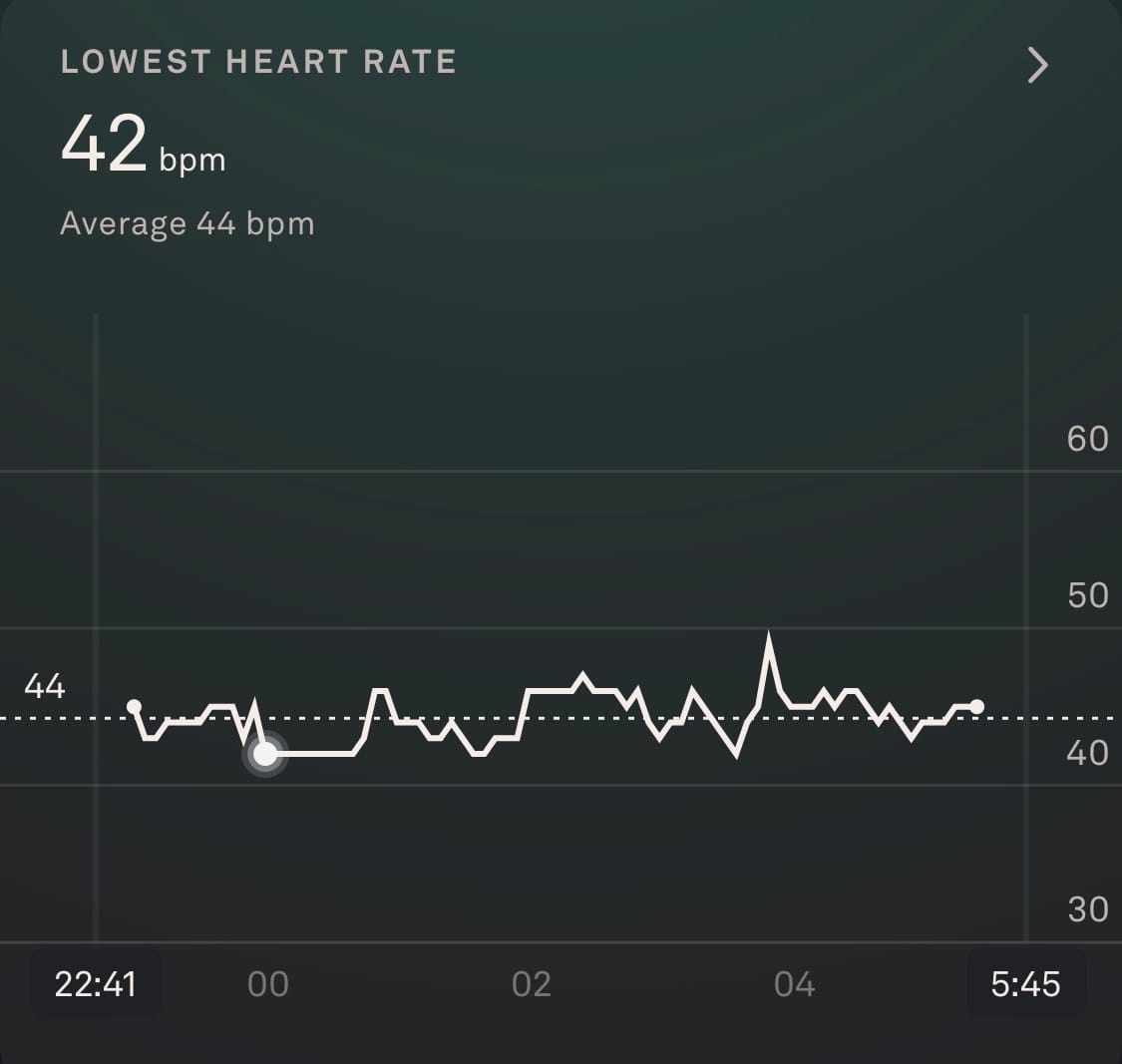
In reality, that "curve" is stitched together from isolated readings five minutes apart:
So how does Oura's night compare to the strap's second-by-second record?
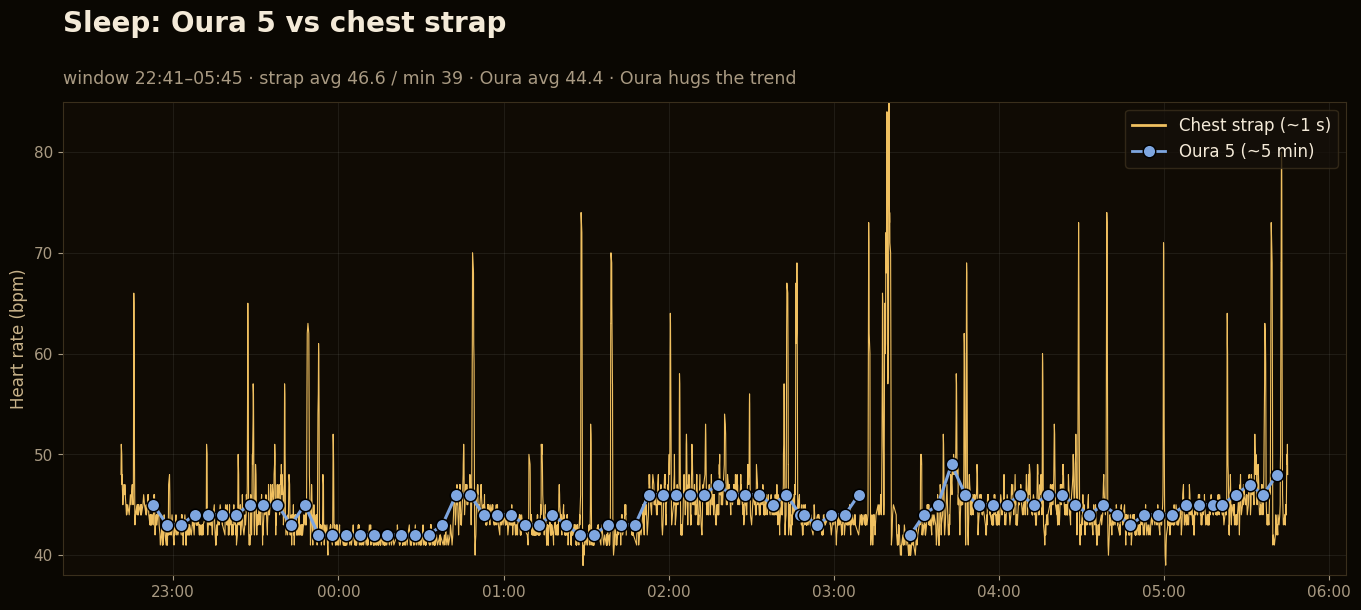
Oura tracks the trend reliably — you could say it flattens the real HR curve. What's fascinating is that its 5-minute sampling misses a whole series of little spikes toward 60+ bpm. That's also why the true average heart rate is slightly higher (46 bpm on the strap vs 44 bpm on Oura).
Those brief bumps are most likely micro-arousals, REM sleep (dreaming, say), or breathing events — little pieces of the sleep-stage mosaic that Oura, with its lower sampling rate, simply never sees. On the other hand, the reason is practical: more sampling means more battery drain. And nobody loves charging. (Except chargers, presumably.)
🌅 The morning gap: an hour without a single beat
One gap really caught my eye — right after waking. Oura's last reading landed at 6:04. Then 67 minutes of radio silence, and the next point didn't show up until 7:11 — already tagged "workout", because the ring finally recognised the start of squash.
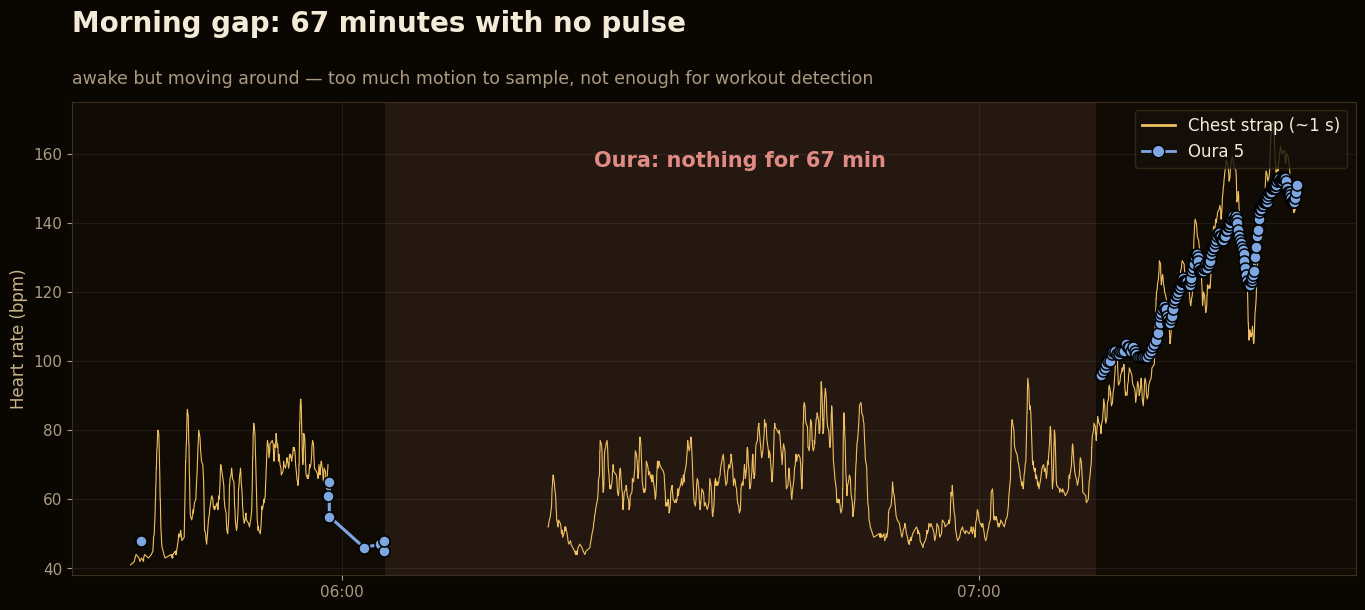
What happened between 6:04 and 7:11?