Wearables & Sauna
Is wearing wearables in a sauna like bringing sand to the beach? Not quite. Sand won’t exceed its operating limits. I took the Garmin Fenix 8, Whoop MG, and Oura Ring 4 into three ~100 °C sauna sessions. What did they measure—and does wearing them in a sauna make any sense?

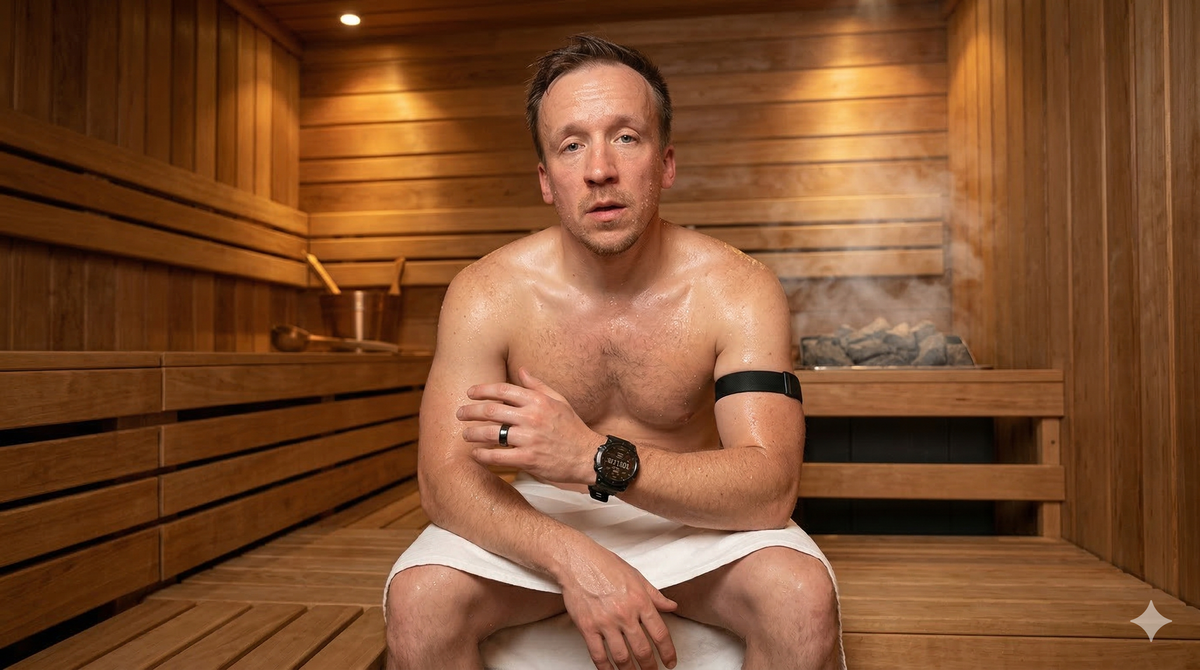
Wearing a smartwatch, ring, or band in a sauna isn’t unusual. But many people may not realize they’re exceeding the devices’ operating limits by 35–55 °C.
Is it risky? And what can we actually learn from the data? I took three wearables into the sauna:
- 💍 Oura Ring Gen4 (smart ring)
- ⌚ Garmin Fenix 8 (smartwatch)
- 🩹 Whoop MG (fitness band)
We’ll look at what they measured, what the community experience is, and whether any of it actually makes sense. But first, some context: how a Finnish sauna affects the body. Let’s dive in 🧖♂️.
Sauna and Physiology
At 100 °C with 10–20% humidity, the skin is exposed to an extreme heat load of about 300–600 W/m². The body responds by massively redirecting blood to the skin and dilating blood vessels in an attempt to cool down.
To maintain blood pressure in this expanded circulatory system, the heart has to significantly increase its output. As a result, 📈 heart rate (HR) rises from a resting 60–80 bpm to 100–150 bpm—and if you really push it (and start sweating heavily), it can climb above 160 bpm.
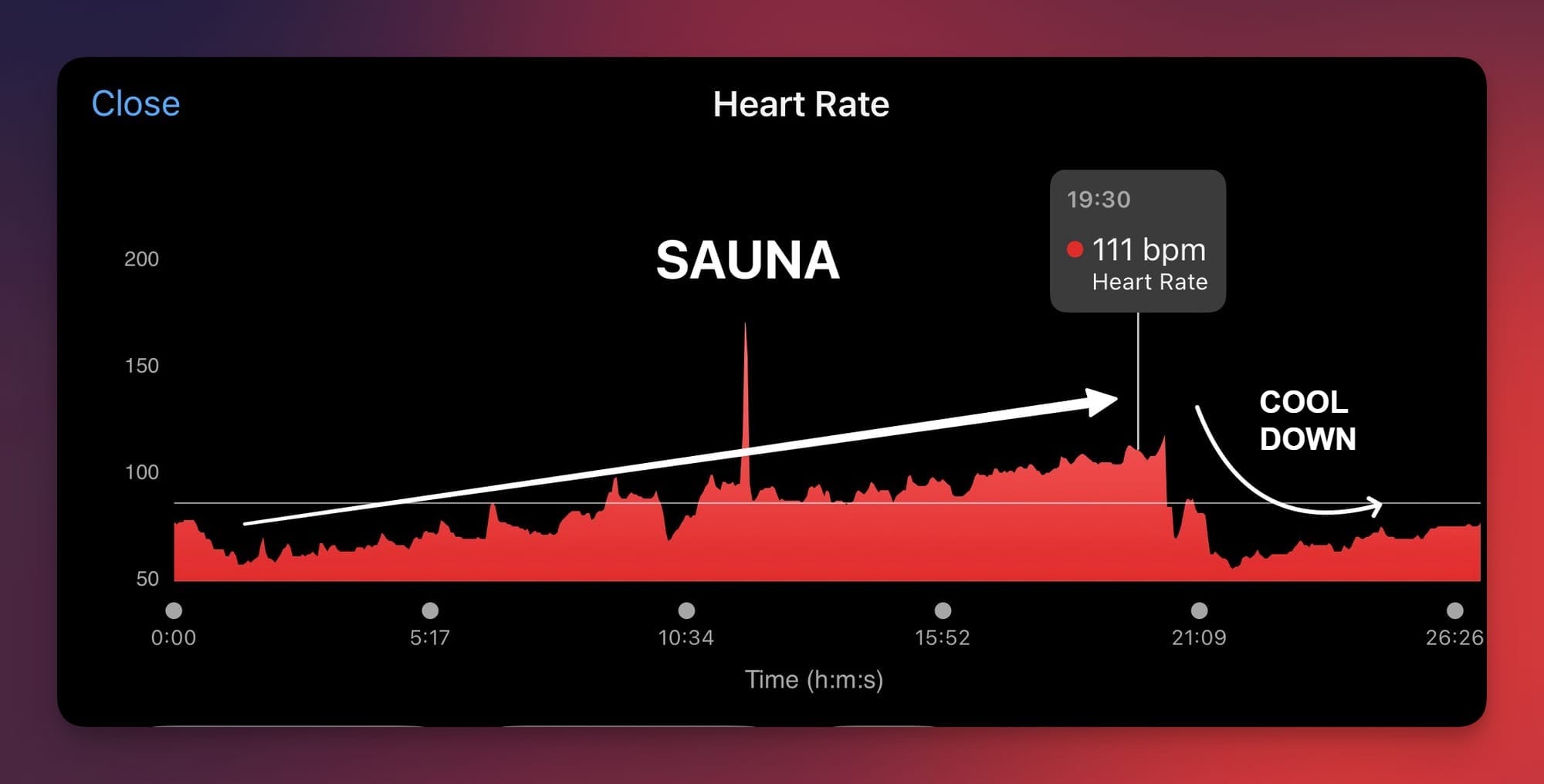
📉 HRV (heart rate variability) drops by about ~62% during a sauna session (sympathetic activation). But around 30 minutes after the sauna, it rises above baseline—this is the positive adaptive effect, when the body recovers and trains the resilience of the nervous system.
This whole process works on the principle of hormesis (from the Greek hormeion = to stimulate or strengthen). It describes the beneficial effects of mild stressors—in this case heat and physiological stress—on living organisms. In other words, stimuli that would be harmful in large doses or long exposure can, in controlled amounts, trigger restorative and strengthening adaptations in the body. 💪
📋 Scientifically proven benefits
The more often you use a sauna, the greater the health benefits. Research shows that regular sauna use 4–7 times per week can reduce the risk of sudden cardiac death by up to 63% and overall mortality by up to 40% [1].
Even 2–3 sessions per week provide significant cardiovascular benefits. The optimal session length is 15–20 minutes at a temperature of 60–80 °C [2,3].
| Frequency | Risk reduction | Main benefits |
|---|---|---|
| 1× per week | Reference value | Basic cardiovascular effects |
| 2–3× per week | ↓ 22% sudden cardiac death ↓ 27% cardiovascular mortality |
Lower blood pressure, improved vascular function |
| 4–7× per week | ↓ 63% sudden cardiac death ↓ 48% heart attack ↓ 40% all-cause mortality |
Maximum cardiovascular protection, improvement of chronic conditions |
Device Technical Limits
| Device | Max operating temperature | Exceeded at 100 °C |
|---|---|---|
| Garmin Fenix 8 | 45 °C | +55 °C |
| Whoop 5.0 | 60 °C | +40 °C |
| Oura Ring 4 | 54 °C | +46 °C |
None of these devices are officially approved for use in a Finnish sauna:
- Garmin explicitly recommends removing the watch before entering a sauna.
- Oura is somewhat contradictory—it says you can wear the ring in a sauna, but also warns against temperatures above 60 °C.
- WHOOP, similarly to Oura, recommends avoiding prolonged exposure to extreme heat.
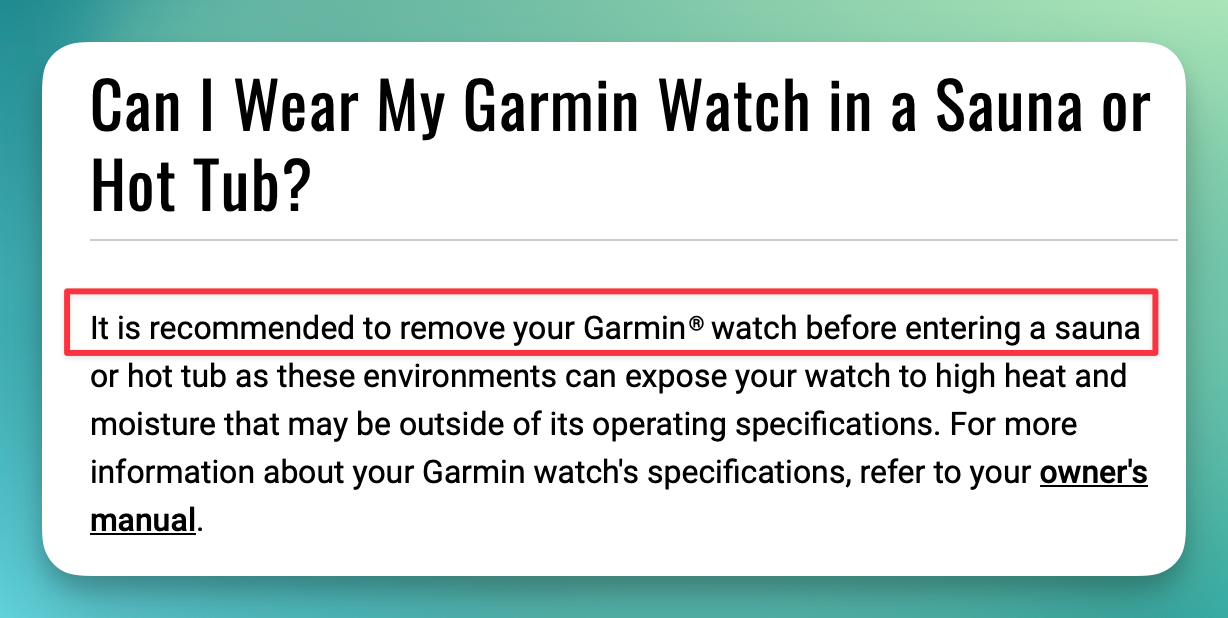
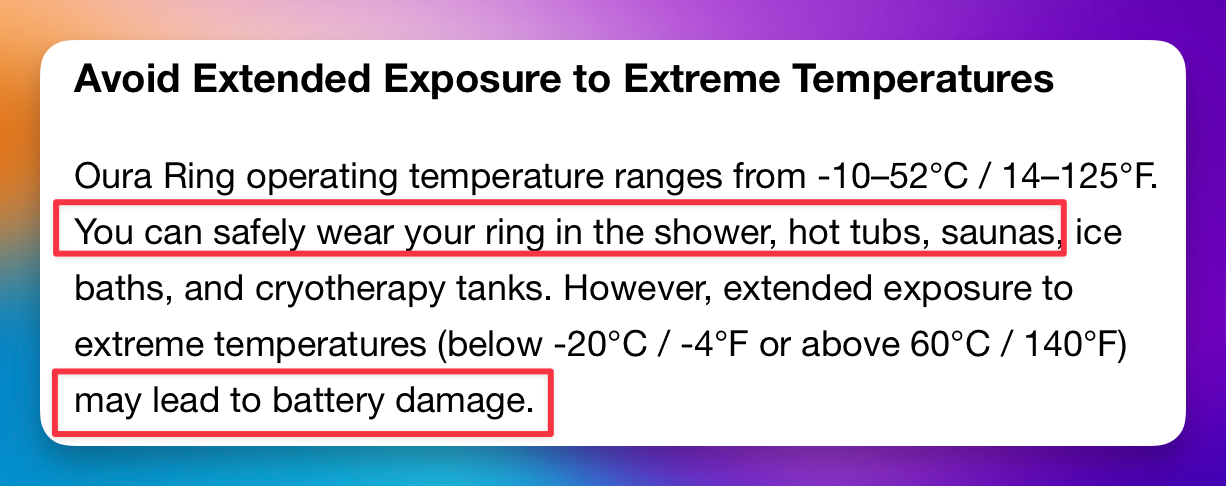
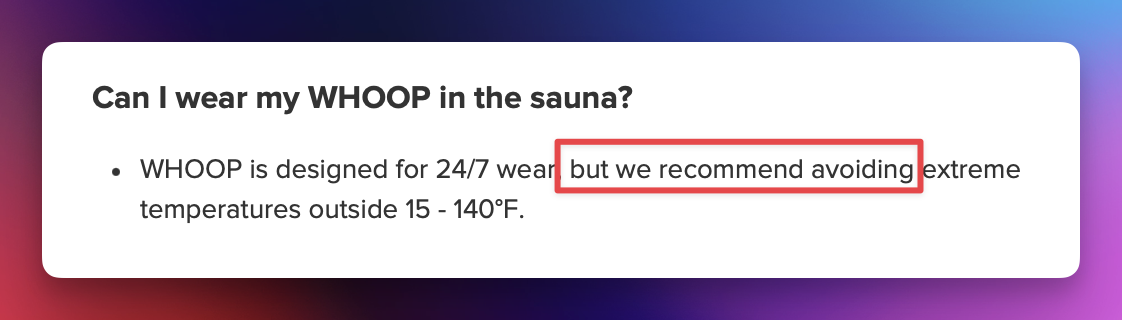
Garmin, Oura a Whoop vs. SAUNA
On the other hand, the human body cools the device, especially if you protect it with something like a wet towel, wristband, or sweatband. Even so, these are still extreme thermal shocks, which modern battery technology doesn’t handle particularly well.
My measured data: interpretation
Garmin Fenix 8
Garmin doesn’t officially offer any activity designed specifically for sauna sessions. However, to at least frame the sessions in the data, I used Sauna Timer from the Connect IQ Store.
In reality, this is just an activity built on top of Garmin’s official “Meditation” profile. According to reviews, this can make Garmin’s Active Intelligence a bit confused—you’ll soon see why…
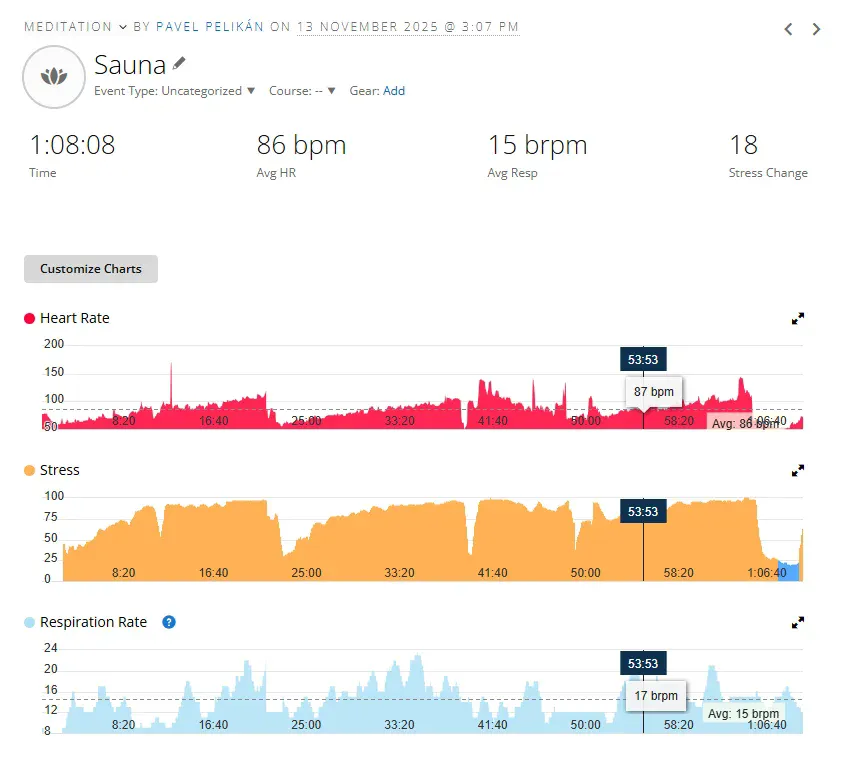
What can we infer from this?
- 171 bpm as the maximum? Studies suggest an average heart rate of 100–150 bpm during sauna sessions, with about one-third of people exceeding 160 bpm. That aligns with a strong thermoregulatory response.However, my recorded maximum is clearly a measurement error.
- Why such a low average? Three sauna sessions with cooling breaks → HR fluctuated between 60 bpm (cool-down period) and 171 bpm (end of the final session). The 86 bpm average is simply a mathematical outcome of these fluctuations.
- Stress? As mentioned earlier, as HR rises, HRV drops, which Garmin interprets as stress. This can be a somewhat confusing outcome for Garmin’s Active Intelligence—after all, meditation isn’t exactly supposed to generate stress. 🙂
Whoop 5.0
WHOOP, which I reviewed in detail here, shows very similar data.
The “Meditation” activity from Garmin was automatically migrated to WHOOP. In it, we can see a similar HR and stress curve, with the difference that WHOOP rates stress on a scale from 0–3.
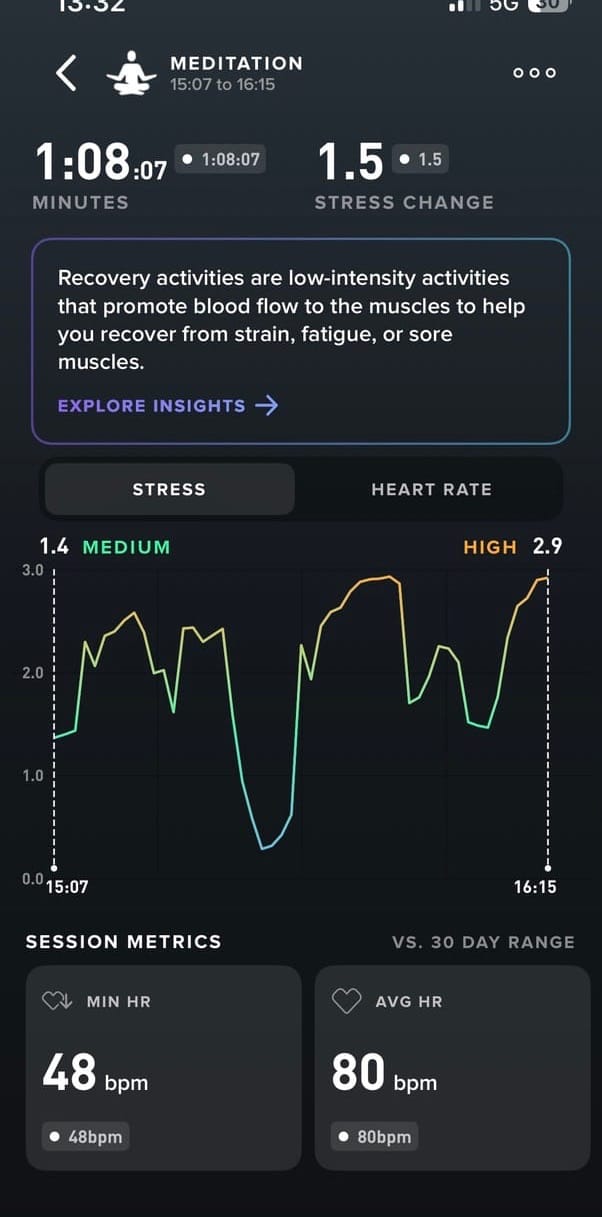
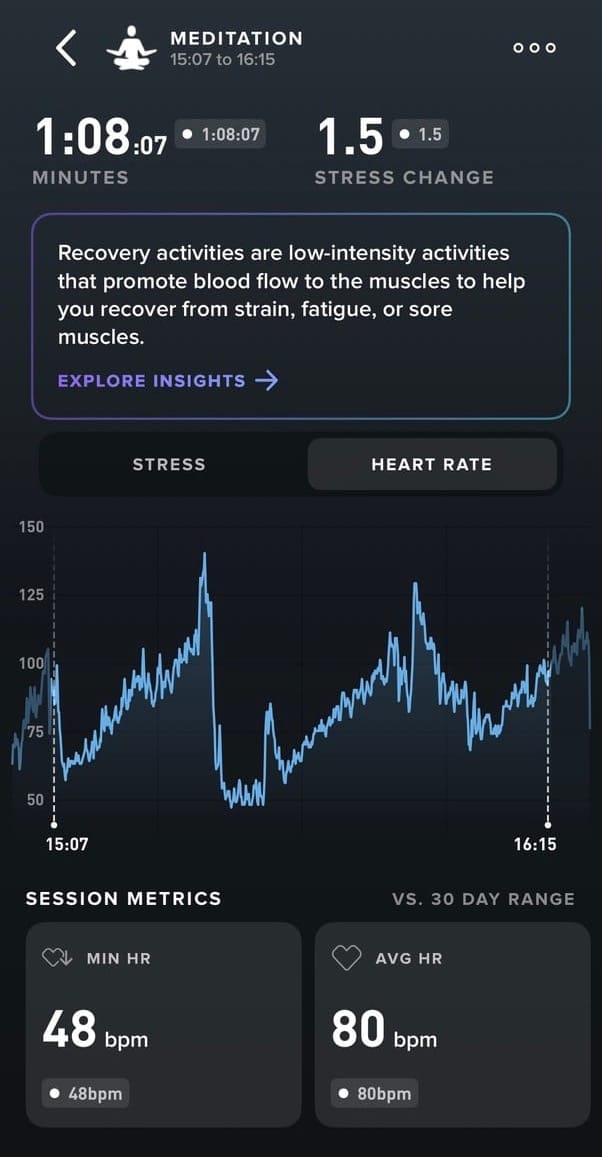
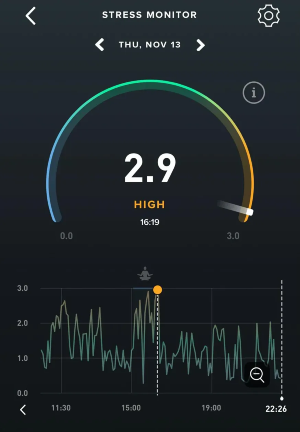
Sauna and Whoop MG
Oura Ring 4
Here we can start with a note from Oura’s documentation:
“Stress can be triggered by exercise, socializing, or sauna use. Your body does not distinguish between physiological and psychological stressors.”
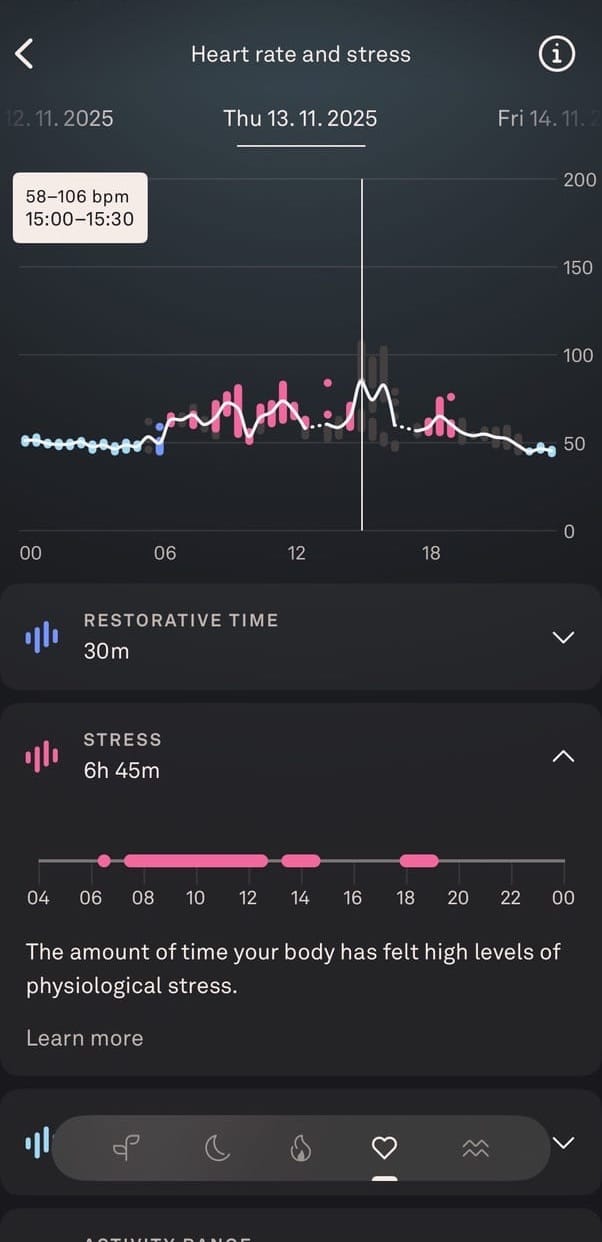
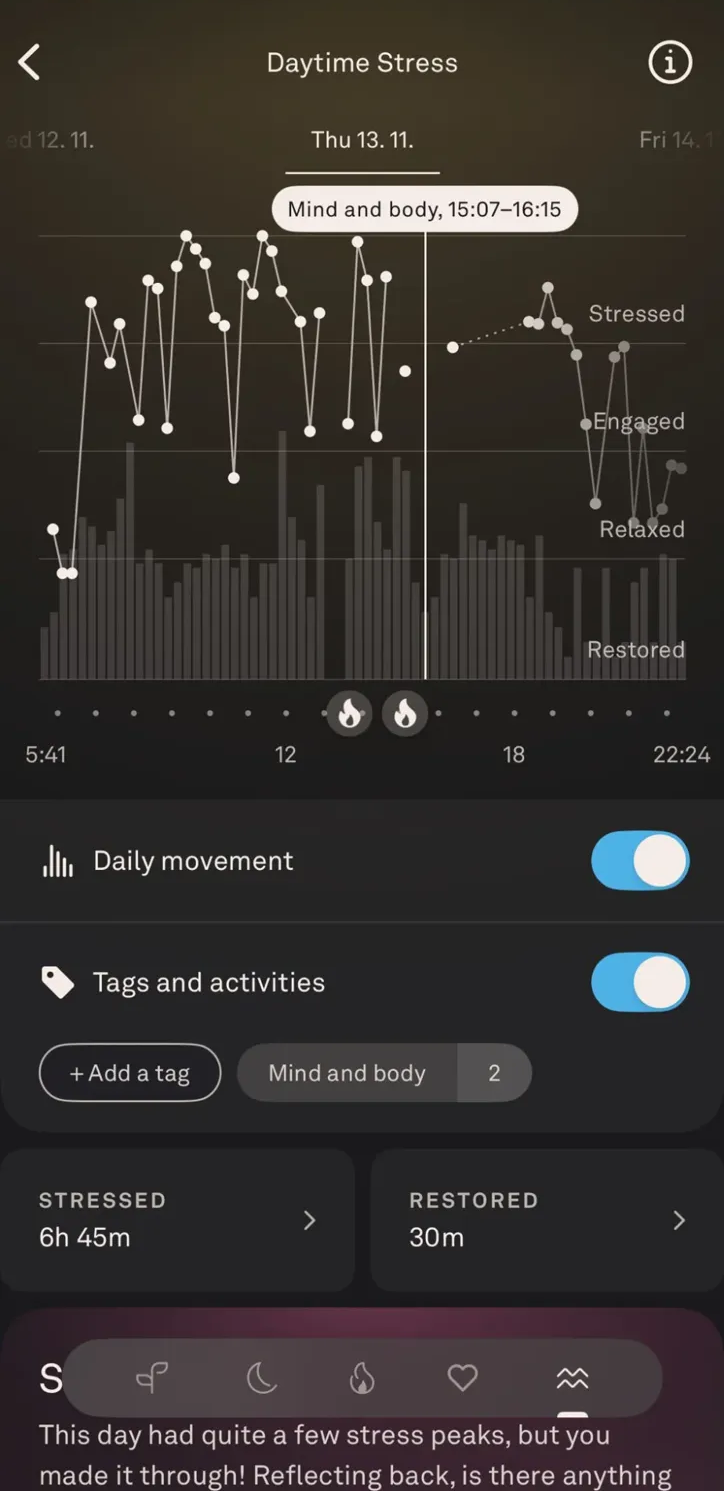
Oura and Sauna
Why does an evening sauna wreck your readiness?
Here I’ll briefly digress to one of the most common frustrations among wearable users who sauna regularly:

What happens after a sauna
After leaving the sauna, it takes 60–90 minutes for core body temperature to return to normal (based on thermoregulation research):
- 0–10 min: Core temperature continues to rise (afterdrop)
- 10–30 min: Peak temperature, intense sweating
- 30–60 min: Progressive cooling
- 60–90 min: Return to baseline, HRV recovery
To fall asleep, the body needs to lower its core temperature by about 0.5–1 °C, but an evening sauna disrupts this process. As a result, sleep quality often suffers: nighttime HR increases (+5–15 bpm), HRV drops (–20–40%), and deep sleep decreases.
The paradox is that a low readiness score doesn’t mean sauna is harmful—it’s mostly about timing, while the long-term health benefits remain.
Conclusion
After testing all three devices in the extreme conditions of a 100 °C Finnish sauna, my verdict is clear: there’s no real point in bringing wearables into the sauna.
✅ The data are predictable and repetitive:
- High HR (100–170 bpm) ✓
- Low HRV (~60% drop) ✓
- Elevated stress ✓
We already know all of this from basic physiology.
❌ The risks outweigh the benefits:
- Potential irreversible battery damage with every session
- Degradation of water resistance (heat expands seals)
- Compromised measurement accuracy (due to extreme vasodilation)
- Possible warranty issues—manufacturers explicitly warn against it
Data from wearables inside the sauna won’t tell you anything new. High HR and low HRV under thermal stress are physiological constants, not discoveries.
The real value lies in long-term tracking: how regular sauna use affects your recovery, adaptation, and overall health. That can only be answered through systematic journaling and observing trends over weeks and months.

For thousands of years, Finns have been using the sauna without Garmin or Oura—with excellent results. The sauna is one place where you truly don’t need technology 🙂.
However, for health data context, it can still be useful to tag and journal your sessions—most platforms support this today.
What about you? Do you wear your wearable in the sauna? 🧖♂️⌚